
Introduction
You dial a prospect's main switchboard for the third time, and you are routed to a generic voicemail again. You know you need a direct line, but finding one feels like a shot in the dark. Companies lose sales hours every week to gatekeepers and automated directories.
The problem is not your pitch; it is the path to the person. A direct dial number eliminates that barrier.
This guide gives you a repeatable eight-step process to source and verify US B2B direct-dial numbers, blending subscription platforms with manual research. Once you internalize this method, you stop dialing into switchboards and start calling the desk.
Key Takeaways
Direct dials are the single highest-impact lever in outbound prospecting. A verified direct dial skips the corporate switchboard and the gatekeeper, so the first ring you hear is the prospect's desk. That speed changes your connect rate overnight.
- Direct-dial advantage: A verified direct dial number allows you to bypass a corporate switchboard, which dramatically improves the speed of connecting with your prospect.
- Tool mix matters: A blend of subscription platforms for bulk lookups and pay-per-use services for targeted precision will cover most prospecting scenarios.
- Verification is non-negotiable: Even a premium tool can serve a wrong number. Always run a real-time line-type check through a service like PhoneValidator before you call.
- Compliance is your shield: The TCPA governs your calls in the US. You, not your data vendor, carry the legal liability for any violation, so maintain internal Do Not Call lists rigorously.
Step 1: Grasp What a Direct Dial Number Is (and Why It Outperforms a Switchboard)

A direct dial number is the specific desk extension or personal line that reaches your prospect's phone without passing through an operator or automated directory. When you use a main switchboard, your identity is unknown to the person filtering the call. You walk in blind. A direct line turns a cold interruption into a planned business conversation.
This matters because switchboards actively block unfamiliar callers as a routine security measure for senior staff. You will burn through five to ten minutes per attempt just to land in a voicemail box.
Direct dials are verified desk extensions that speed up connecting with prospects by bypassing gatekeepers and switchboards. The direct dial database from a focused provider contains information segmented by region, industry, and company size, often filtering through 70+ data fields to help you pinpoint just the right contact. Data can be collected from government records, business listings, and yellow pages, all triple-checked by in-house data experts.
Every minute you spend on hold lowers your potential pipeline. A direct line increases your effective talk time by getting you to the decision-maker quickly.
Step 2: Assemble the Required Lookup Inputs for Any Tool
You cannot pull a phone number from thin air. A bad input will return a dead line, so start each search with a clean data set. Assemble these three core pieces before opening any prospecting tool:
- Full name and title: The prospect's complete first and last name, plus their current role. A generic first name without the title often pulls records for the wrong person.
- Company domain and URL: The exact company website. A valid domain helps a tool cross-reference a professional email pattern that often maps to a direct dial.
- LinkedIn profile URL: The unique public profile address. This is the primary key that tools lock onto for retrieving work history and enrichment data.
The first two inputs ground every lookup in reality. If you skip the domain, you may receive a recycled number from a previous employer. A partial name creates duplicates. Treat the LinkedIn URL as the authoritative index, most enrichment platforms pivot their matching algorithm on it before pulling work email patterns and direct dials.
Step 3: Choose the Right Sourcing Channel: Databases, Public Profiles, and Manual Research
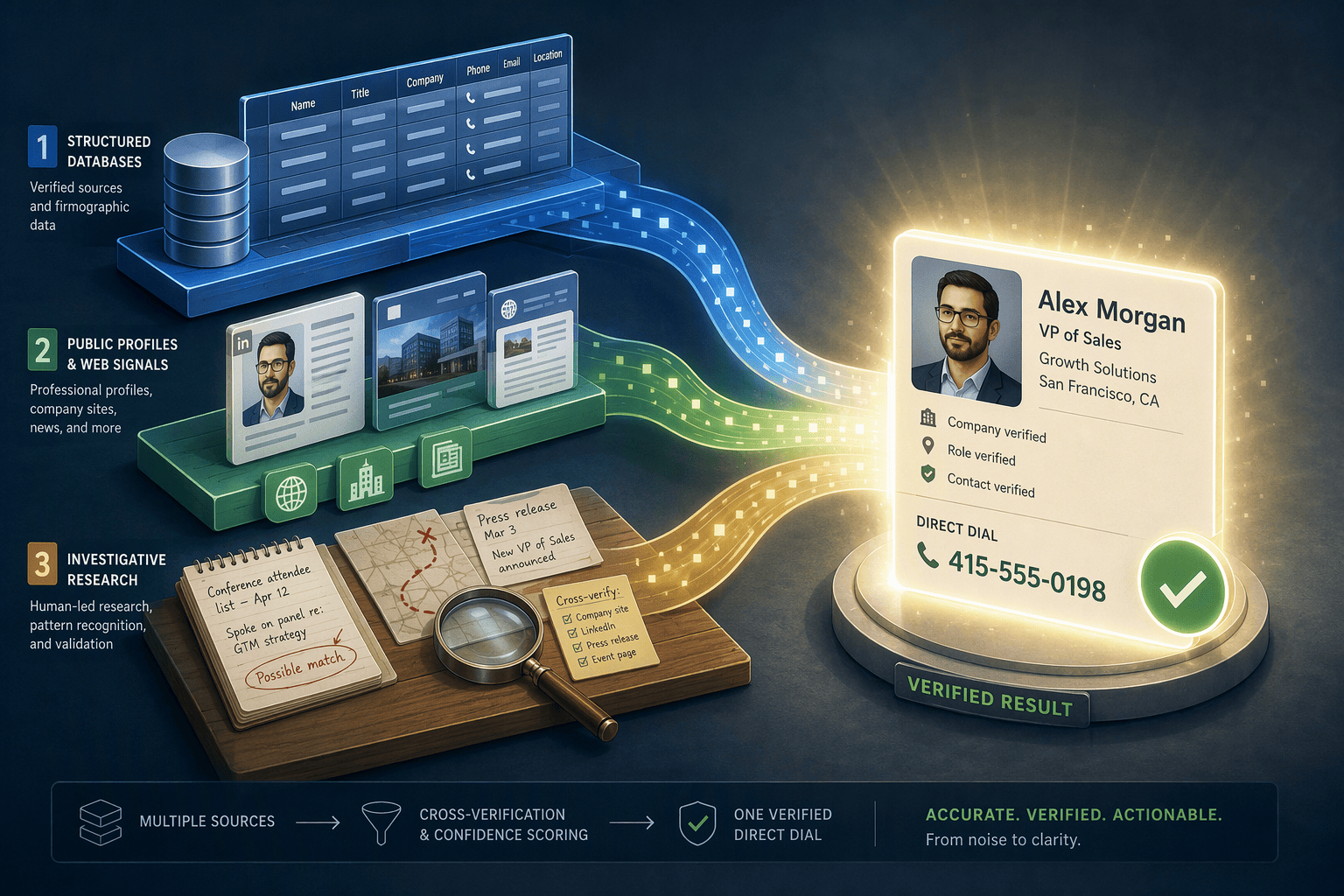
No single source covers every US B2B number. A smart process mixes static databases, public signals, and old-fashioned deduction. Known databases give you immediate scale. Providers build custom B2B solutions from scratch based on your preferred industry, location, job roles, and company size, with each dataset manually researched. One vendor ensures 95%+ data accuracy through their verification process.
Public signals are your low-cost intelligence layer. A CFO leaving a phone number in a conference slide deck or a local business award press release is a legal, verified source that no database may have captured yet.
The gap is when you have zero listed number. Here you reverse-engineer by finding the internal email pattern, like [email protected]. Then you call the general number and manually dial the extension pattern linked to the name to reach the desk.
This mixed method means you never rely on a single stale record. You verify a database lead against a live public post, turning a cold pull into an informed warm call. ## Ready to Transform Your Sales Process? Join thousands of sales professionals using PeakAI to find accurate contact information and close more deals.
Step 4: Select a Platform or Pay-Per-Use Service That Specializes in US B2B Direct Dials
Your choice sits between subscription platforms for scale and pay-per-use services for precision. Subscription tools like Apollo.io and Lusha work on a monthly credit system. Apollo.io starts at $49 per month and requires a subscription. You commit to a spend in exchange for a regular flow of numbers. The trade-off is that they have limited built-in verification of dial accuracy, so you must check the line yourself.
Lusha reports no refund for wrong numbers.
Pay-per-use finders give you a different model. You pay a fee for a single contact, drawn from fresh web scraping. These suit targeted account selling where you need only a handful of high-value numbers in a quarter.
Be careful of a tool's geography. India-focused platforms like PeakAi are optimized for Indian B2B markets and deliver 91% accuracy for those contacts. They do not have the specialized US business data coverage you need for this specific activity.
Step 5: Understand the Pricing Models and Guarantees Before You Spend

The cost structure will shape your dialing volume. A subscription gives you a bucket of credits. You might pay PeakAi's starting rate of $9 for 250 credits, with a phone number costing 5 credits and a director phone costing 7 credits. When the credits expire monthly, unused ones vanish, so you dial or lose them.
Accuracy guarantees act as a sales safety net. You will see claims of 91% accuracy for phone numbers. However, phone accuracy is not binary. A guarantee means the format and carrier data were correct at the time of lookup. It does not confirm the person still sits at that desk.
Poor-quality data costs you a credit, but not a refund for a bounced call. Lusha has no refund for wrong numbers. In contrast, PeakAi says it offers a 100% credit refund guarantee, which can protect your test budget when you start.
Step 6: Verify the Number's Accuracy Before You Dial
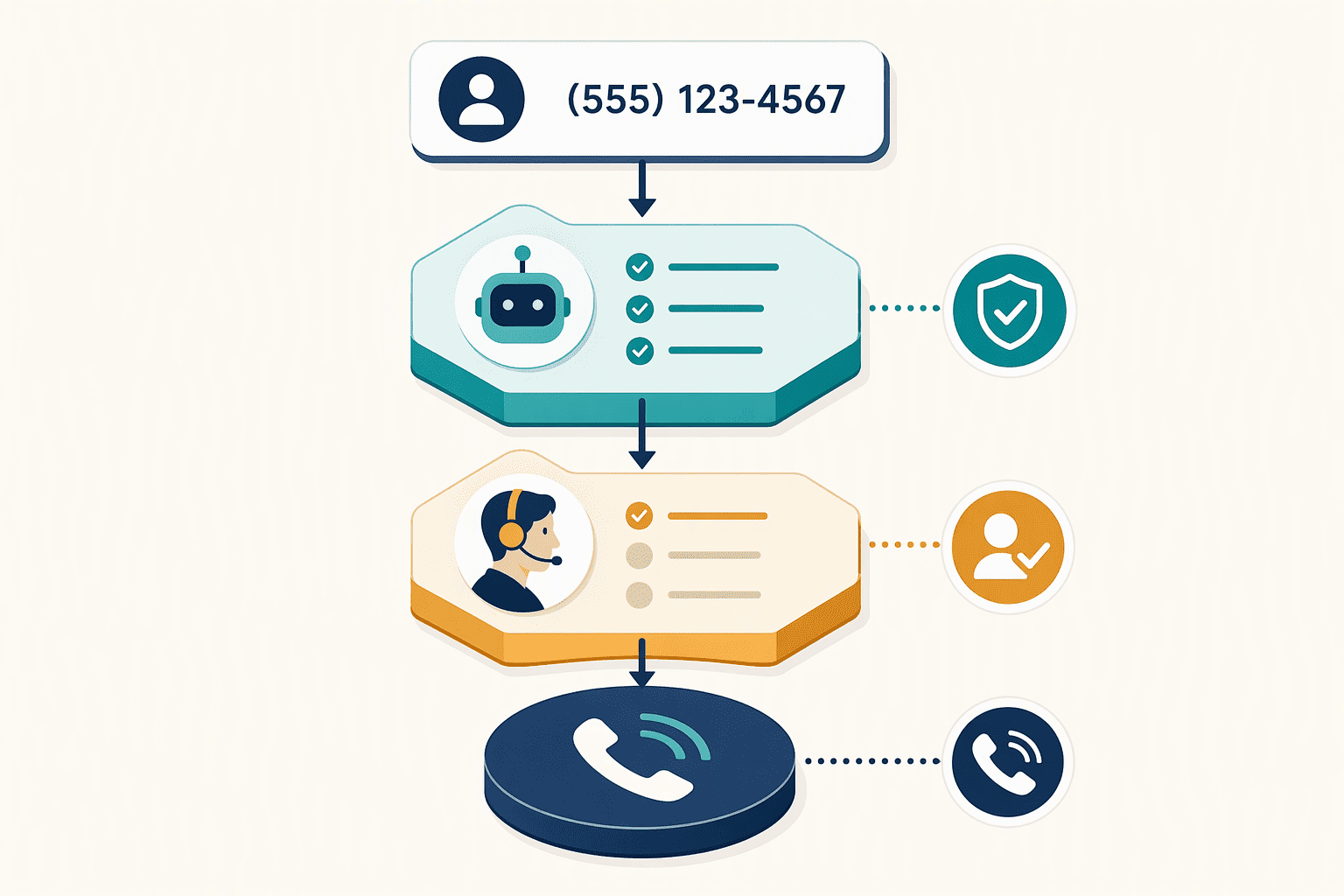
A wrong number burns your sender reputation and risks a compliance misstep. The verification step splits into automated line-type checks and a fast human-sound test. Use this table to match the tool to the task:
| Verification Layer | What It Does | How to Apply It |
|---|---|---|
| Real-time validation | Checks line type (mobile, landline, VoIP) and active status against carrier data | Run the number through PhoneValidator or Numverify before it leaves your dialer |
| Softphone flagging | Assigns confidence levels (safe, risky, empty) to contact fields instantly | Use a dialer that flags invalid numbers in real time, stopping you from dialing dead lines |
| Manual sound check | Confirms the line is answered by the named person | Call the number on a softphone. If a generic company greeting plays, mark it as unverified |
Step 7: Integrate the Workflow into Your CRM and Sales Engagement Stack
A phone number that lives outside your CRM is an abandoned opportunity. You need the enriched data to land inside your system fast so it can trigger the next part of your sequence, not sit in a spreadsheet.
- Push the data into your CRM first. Use a native connector for Salesforce, HubSpot, Pipedrive, or Zoho to map the new direct dial straight to the correct contact record.
- Test with a low-credit lookup before a full procurement cycle. PeakAi runs in a Chrome extension and grabs the number directly from a prospect's LinkedIn page. It's a lighter option that confirms the data flow works.
- Act on the number immediately once it sits in the CRM field. Set Outreach.io to drop the prospect into a call-specific cadence the moment the direct dial lands.
Step 8: Navigate TCPA, CAN-SPAM, and Other Compliance Guardrails
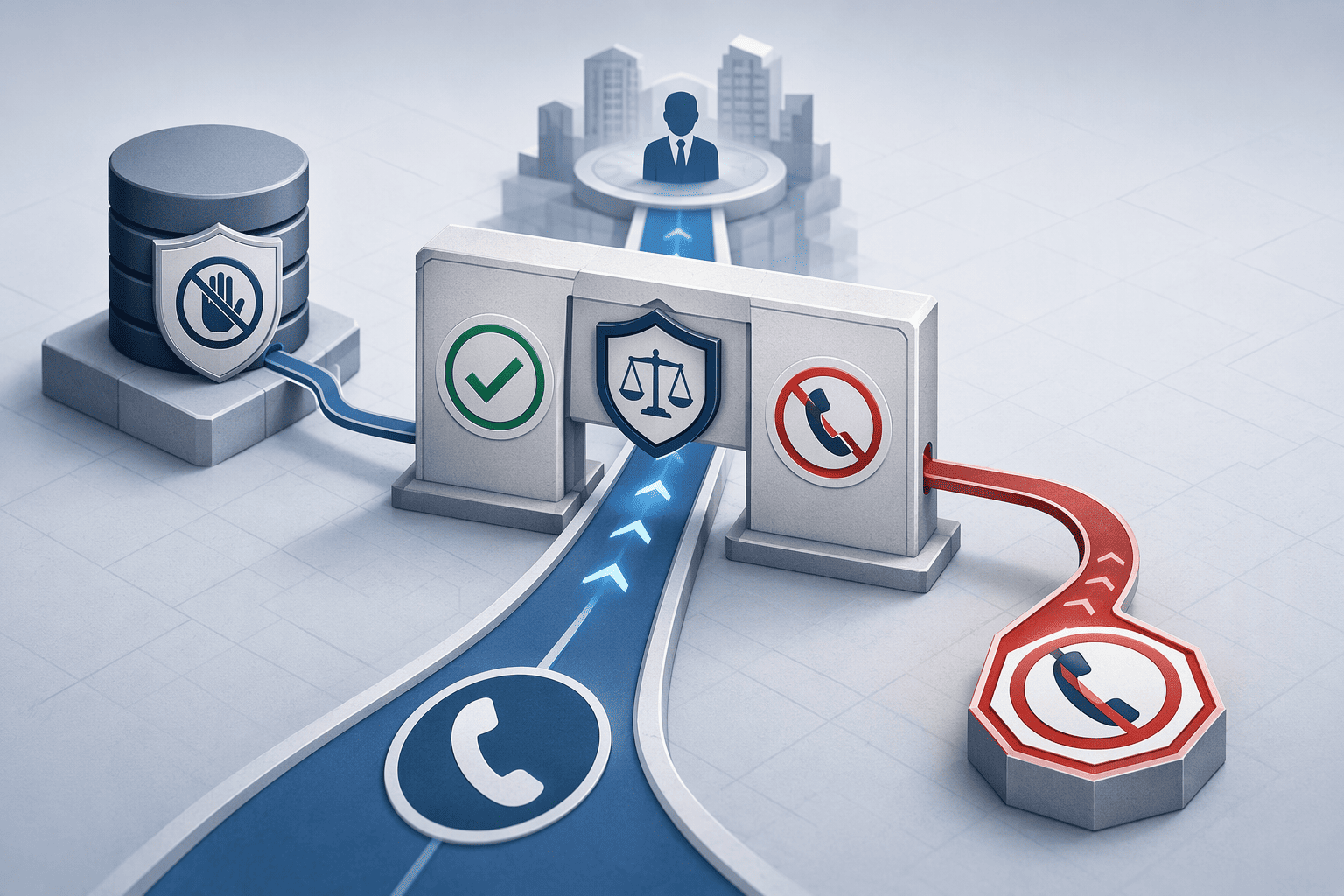
The law does not care where you bought the data. You remain liable for every call placed within US borders.
The Telephone Consumer Protection Act requires prior express consent for autodialed or prerecorded calls to a cell phone. Business-to-business calls enjoy a partial exemption, but you still cannot autodial a personal mobile phone on file with the wrong consent. Keep your internal Do Not Call list updated with every request to stop calling, and log it in a central register accessible to your dialing software.
AI-powered dialers face a tighter rulebook in 2026. Regulators are narrowing the definition of an autodialer, and any automated system that generates and calls numbers in sequence carries significant risk if you cannot prove consent.
CAN-SPAM governs commercial email. For phone outreach, stay inside the TCPA framework. Data vendors offer no safe harbor: their warranty is a credit back, while your exposure is a federal fine. Verify, log consent forms, and scrub against the DNC list before you press dial.
Conclusion
Getting a direct dial is a technical exercise. Turning it into a pipeline is a compliance exercise.
PhoneValidator confirms whether a sourced number rings the desk you aimed for, flagging dead lines before your team wastes a single call.
On the legal side, the TCPA draws a line between an uninvited interruption and a planned business conversation. B2B calls aren't automatically exempt. You still need prior express written consent when an autodialer or artificial voice is part of your stack. Skip that consent and you inherit statutory damages risk.
A practical routine works like this. Sourcing verifies ownership. PhoneValidator confirms the line is live.
And your compliance checklist checks consent, do-not-call registration, and time-zone rules before a dialer ever spins up. The tech gets you to the phone. Your discipline keeps you out of court.
Frequently Asked Questions
What are the most effective methods and tools to find direct dial phone numbers for B2B prospects in the US?
A combined approach works best. Use subscription-based databases like Apollo.io or Lusha for bulk, ongoing searches. Supplement with pay-per-use tools like Seamless.ai for high-priority accounts. Finish with manual public-source checks for off-database verification.
How do pay-per-use contact finders compare with subscription platforms like Lusha and Apollo.io for US B2B prospecting?
Subscription platforms charge a fixed monthly fee for a credit allowance, ideal for high-volume daily dialing. Pay-per-use charges only for the contacts you look up, which suits infrequent, strategic searches. Subscription tools often lack per-number refunds, while some pay-per-use options provide credit-return guarantees.
What legal and compliance considerations (e.g., TCPA, CAN-SPAM) apply when cold-calling US business contacts obtained from data vendors?
Under the TCPA, you need prior express consent for autodialed or prerecorded calls to mobiles. B2B calls have some exemptions, but you stay legally liable. CAN-SPAM applies only to email, not voice. Maintain an internal Do Not Call list and know that data vendors do not shield you from fines.
Are India-focused B2B contact tools like PeakAi effective for finding direct dials in the US market?
No. PeakAi is optimized for Indian B2B markets and provides very high accuracy specific to those regional contacts. It lacks the deep, specialized US business data coverage that platforms built primarily for the North American market, like ZoomInfo, can provide.
How can you verify the accuracy of a direct dial phone number before making a sales call in 2026?
Verify a number before dialing it with a three-step process.
- Perform a manual sound check.
- Run the number through a real-time validation service like PhoneValidator or Numverify to confirm the line type is correct and active.
- Use a softphone dialer that flags invalid numbers instantly before connecting your voice to the call.
Sources
- 7 LinkedIn Prospecting Tools That Verify Phone Numbers - thepeakai.com
- PeakAI - Professional Network Contact Finder | 91% Accuracy | B2B Leads Starting $9 - thepeakai.com
- Direct Dials – B2B Data Corp - b2bdatacorp.com
- B2B Database Provider India | Verified Global Business Data | Sk Web Global - skwebglobal.com