
Introduction
Your sales team just burned through another 50 credits on a top-rated contact finder. The dashboard claimed 92% accuracy. In India, only 32 emails landed and just 10 phone numbers connected.
Generic global algorithms trip in a market where professionals switch jobs every 18 months and phone numbers cycle even faster. PeakAi built a dual-validation engine for that volatility, verifying every lead against GST registration databases and active telecom sources before you ever hit export.
Without India-specific verification at the source, the gap between the dashboard number and the actual connect rate stays wide.
Key Takeaways
Global accuracy claims mask a crisis that hits Indian sales pipelines hard. These five points frame the reality you need to test before signing any annual contract.
- Accuracy gap is structural: Global platforms advertise 85 to 95% email accuracy but independent testing shows India-specific find rates crash to 50 to 65% due to job volatility and alternate email usage.
- Dual-validation outpaces single-pass engines: Platforms like Apollo.io see direct-dial claims of 95% drop to approximately 50 to 53% for Indian phone numbers, while India-first dual-validation maintains an 85 to 90% verified accuracy band.
- Compliance is the first filter: Enrichment-based tools using third-party databases avoid LinkedIn Terms of Service violations that expose scraping-based tools to account suspension risk.
- “Unlimited” plans carry hard caps: Subscription tiers advertising unlimited contacts typically enforce fair usage policies of 500 to 1,000 contacts per month before throttling, making per-contact cost calculations key.
- India-specific signals beat global algorithms: GST registration matching, mobile carrier identification, and job-tenure stability flags are the verification signals that predict Indian contact validity, not generic email-format guessing.
What Defines Truly Accurate LinkedIn Contact Discovery and Why Advertised Figures Mislead
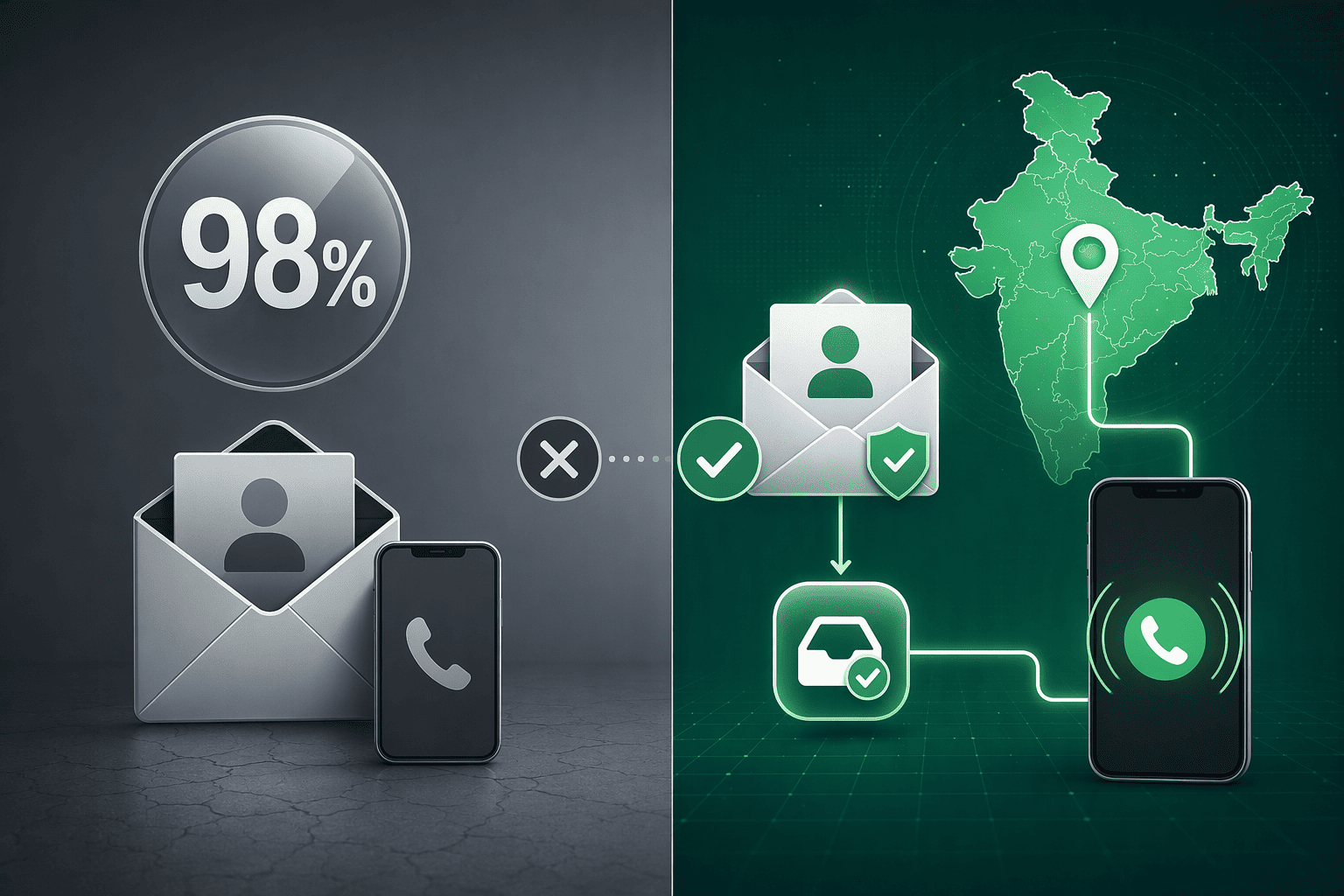
Accuracy in LinkedIn contact discovery means verified deliverability and direct-dial connectivity. When a platform reports 92 to 95% accuracy, it is often measuring whether an email passes a format validation, not whether that email reaches a live inbox or whether a phone number rings the decision-maker. In India, that distinction costs you pipeline.
Independent field testing reveals that tools achieving 85 to 95% global accuracy routinely deliver just 50 to 65% verified Indian contacts. The market's unique data volatility drives this gap.
Indian professionals change jobs at rates that stale databases cannot track, and many maintain alternate email addresses completely disconnected from their LinkedIn identities. A one-pass verification engine that works in London or Chicago fails in Mumbai because it is matching against outdated or irrelevant signal layers.
What makes a platform truly accurate for Indian profiles is its verification methodology. A tool that cross-references contact data against GST registration databases, performs real-time carrier lookups, and flags job-tenure instability before delivering a result is measuring deliverability. Until Indian sales teams judge tools by the verification signals they apply, the advertised percentage tells them almost nothing useful.
How PeakAi's India-First Dual-Validation Compares to Global Platforms
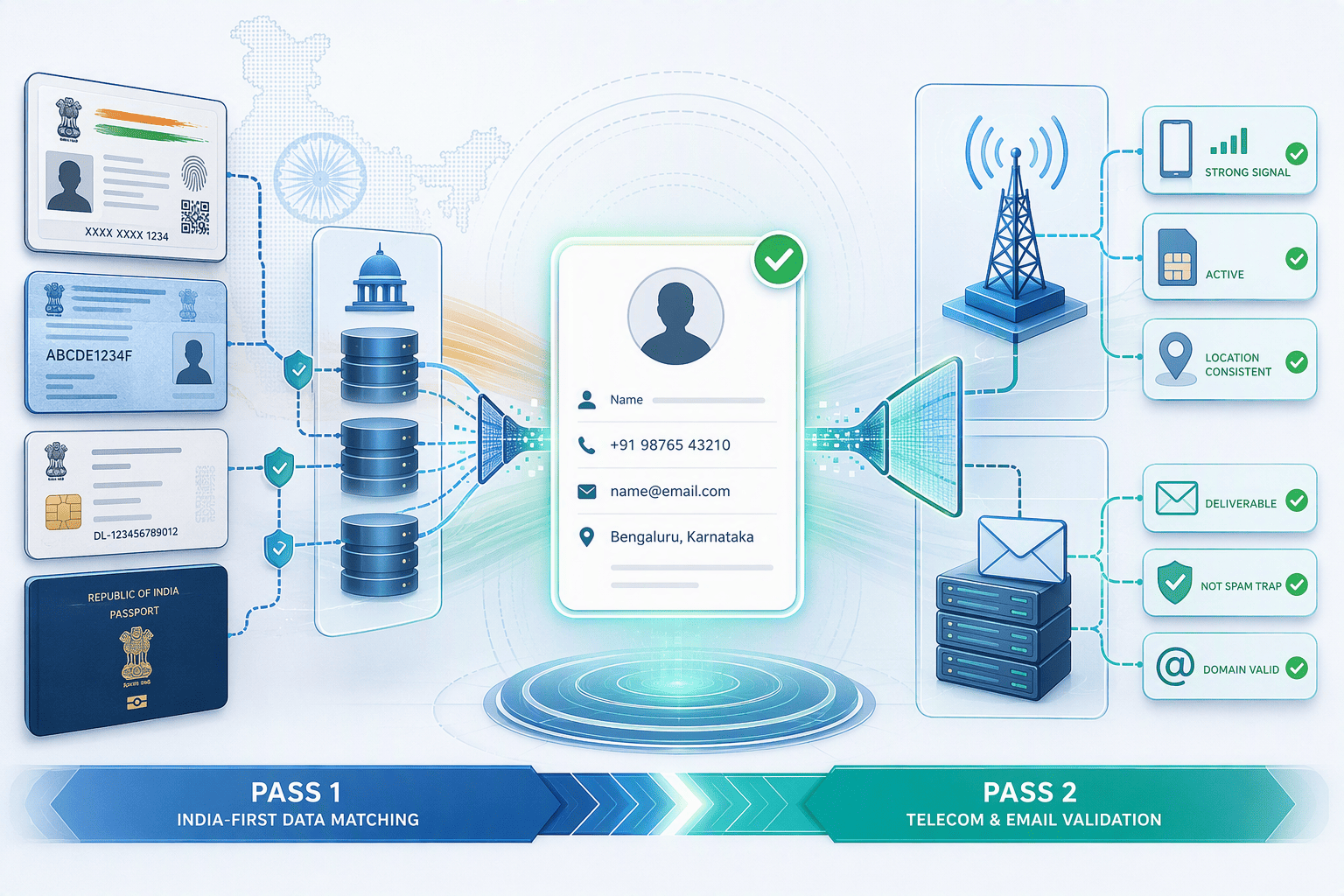
PeakAi runs a dual-validation flow built specifically for Indian contact data. The first pass checks a prospect against India-specific data sources: GST registration databases, Ministry of Corporate Affairs filings, and local business registries. The second pass cross-references that matched entity against active telecommunications databases to verify phone connectivity and email deliverability in real time. Only contacts that survive both validation layers are returned, and PeakAi attaches a confidence score and a compliance timestamp to each exported record.
Global platforms operate on a fundamentally different architecture. Apollo.io, Lusha, and Hunter rely on single-pass algorithms or aggregated third-party databases without regional verification depth. The result is a documented 50 to 53% direct-dial accuracy floor for Indian phone numbers on Apollo.io, against its 95% advertised global claim.
A single-pass engine that works for US contacts breaks down when it encounters the fragmented signal environment of Indian profiles. The engine checks an email string for syntax and a domain for a mail server. It does not check whether that domain is registered with the MCA or whether the phone number returns a live ring on an Indian carrier.
PeakAi's dual-validation approach narrows that gap to approximately 85 to 90% verified Indian accuracy. The model queries business registries and telecommunications databases, then runs deliverability checks before download. If a team imports a list where the platform's underlying Indian accuracy sits at the floor rather than the advertised percentage, the accuracy gap will persist across every campaign run from that data. For Indian sales teams evaluating tooling in 2026, the deciding factor is whether the platform validates against Indian-specific entity sources or treats India as just another geography in a global averaging exercise.
The Compliance-First Architecture: Enrichment vs. Scraping Risk Explained

Every contact finder sits on one side of a line that determines whether your LinkedIn account survives the quarter. The line is data provenance.
Enrichment-based platforms query third-party databases, business registries, and telecommunications records. They never touch LinkedIn's live profile interface. Scraping-based tools do the opposite, they harvest data directly from profile fields you see on screen. That second approach breaks LinkedIn's Terms of Service outright, and LinkedIn's enforcement teams have gotten faster at detecting it.
| Feature | Enrichment (Third-Party DB) | Scraping (Live Profile Mining) |
|---|---|---|
| Data source | Business registries, GST databases, telecom records, public filings | LinkedIn profile HTML and DOM fields |
| LinkedIn ToS compliance | Generally compliant; does not interact with LinkedIn interfaces | Violates ToS; exposes user account to suspension |
| Verification signals | Confidence scoring, syntax-domain-deliverability checks, registry cross-references | Raw field extraction with no verification layer |
| Data provenance | Timestamped source attribution per record | No disclosed provenance; scraped snapshot |
| Examples | Kaspr (third-party DB enrichment), Evaboot (professional data aggregation), PeakAi (GST and MCA cross-referencing) | Unnamed browser extensions performing real-time DOM extraction |
Browser extensions add a wrinkle here. An extension that pulls data from a third-party database sits in a compliance gray area, acceptable if it respects rate limits and user interaction boundaries. But an extension that mines live profile data directly carries suspension risk regardless of how politely it requests the DOM. The extension is the delivery mechanism; the data source is what the compliance team cares about.
Confidence scoring, when a tool discloses it, gives you a signal of verification strength that holds up under scrutiny. It tells you how aggressively the platform cross-referenced the record. What it does not do is promise you a specific accuracy rate the underlying data cannot support. If a tool's match rate lands at 70% and sales leaders budget around 100% because they misread the confidence tier, the accuracy gap will persist no matter what the dashboard says.
A Step-by-Step Methodology to Evaluate Real-World Accuracy and Cost-Effectiveness in 2026
Indian sales teams cannot rely on vendor accuracy claims. The following framework lets you audit any contact discovery tool against your target market before committing budget.
- Define India-specific accuracy metric: Measure verified deliverability rate (emails that reach inboxes without bounce) and direct-dial connect rate (phone numbers that ring the decision-maker). These replace the syntax-validation figures vendors typically quote.
- Build a test contact list: Compile 50 to 100 Indian profiles across cities, industries, and seniority levels. Include profiles with known job changes within the past 12 months to test recency handling.
- Run parallel tool trials: Test at least three platforms simultaneously on the same contact list. Include one India-first tool and two global platforms to establish comparative baselines.
- Measure deliverability and direct-dial rates: Send test emails and place verification calls. Count bounces, wrong numbers, and disconnected lines. This real-world find rate is your accuracy benchmark.
- Calculate cost-per-verified-contact: Divide total spend by verified contacts delivered. Under credit-based models like PeakAi's ₹675 for 50 contacts, the math stays transparent. Under subscription models with 500 to 1,000 contact fair usage caps, factor in throttled months where overage stops cold.
India-Specific Contact Coverage and Verification Signals That Matter
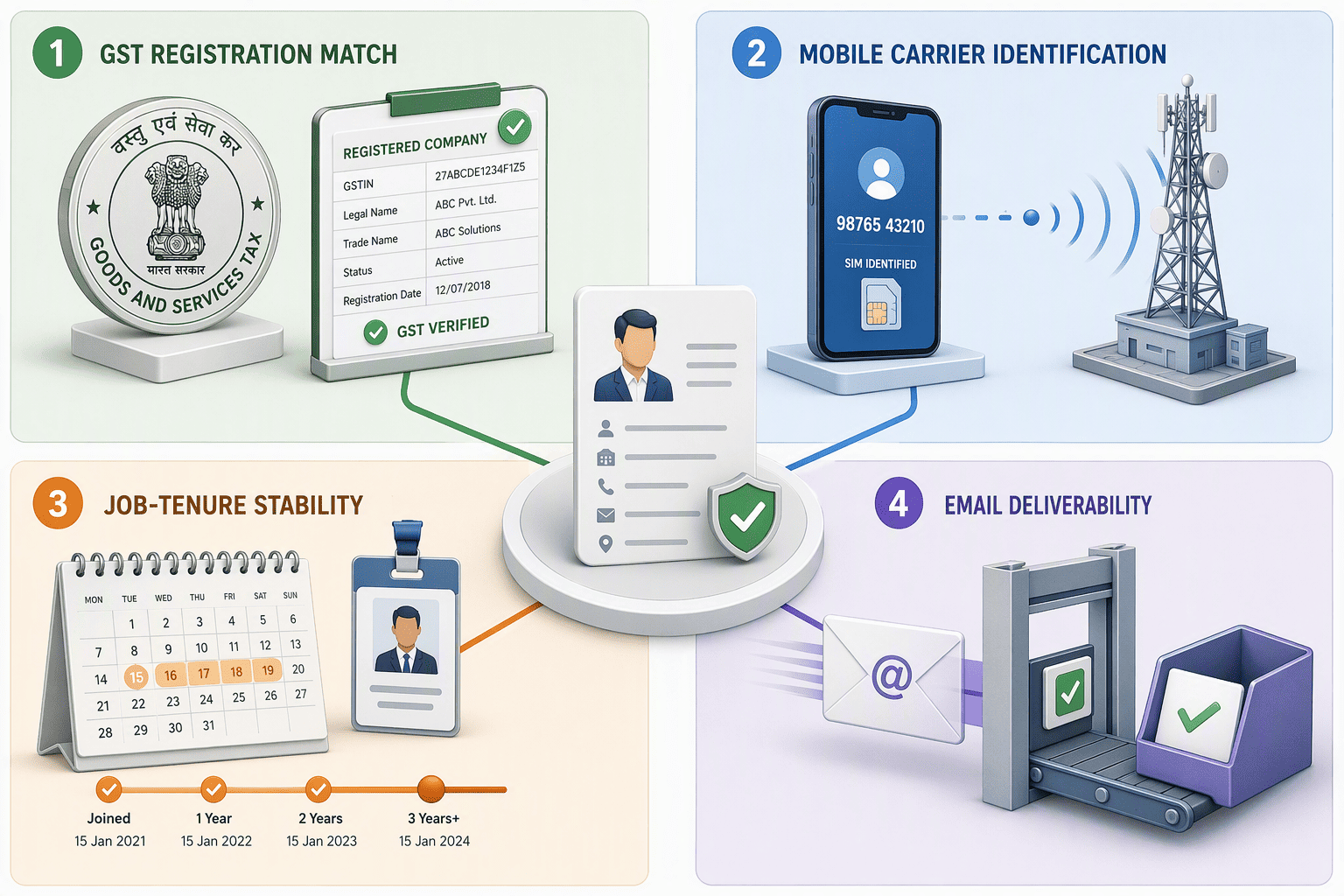
Indian contact data quality depends on four key verification signals that global platforms rarely apply:
- GST registration matching: Confirms that a company entity is active and registered, tying a prospect's declared affiliation to a government-verified record.
- Mobile carrier identification: Pinpoints whether a phone number is active and which operator services it, filtering out disconnected or recycled numbers before they enter your CRM.
- Job-tenure stability: Addresses India's highest-risk variable, rapid professional movement, by checking recent employment transitions and cross-referencing alternate email patterns that Indian professionals use, reducing the bounce rate that single-pass tools cannot control.
- Domain-to-company mapping: Verifies that a prospect's email domain resolves to their claimed employer, catching misattributed contacts that generic email-format guessing misses.
These four signals, applied together, outperform any algorithm trained on global averages.
Pricing Models in Practice: Credit-Based Control vs. Subscription Fair-Usage Caps
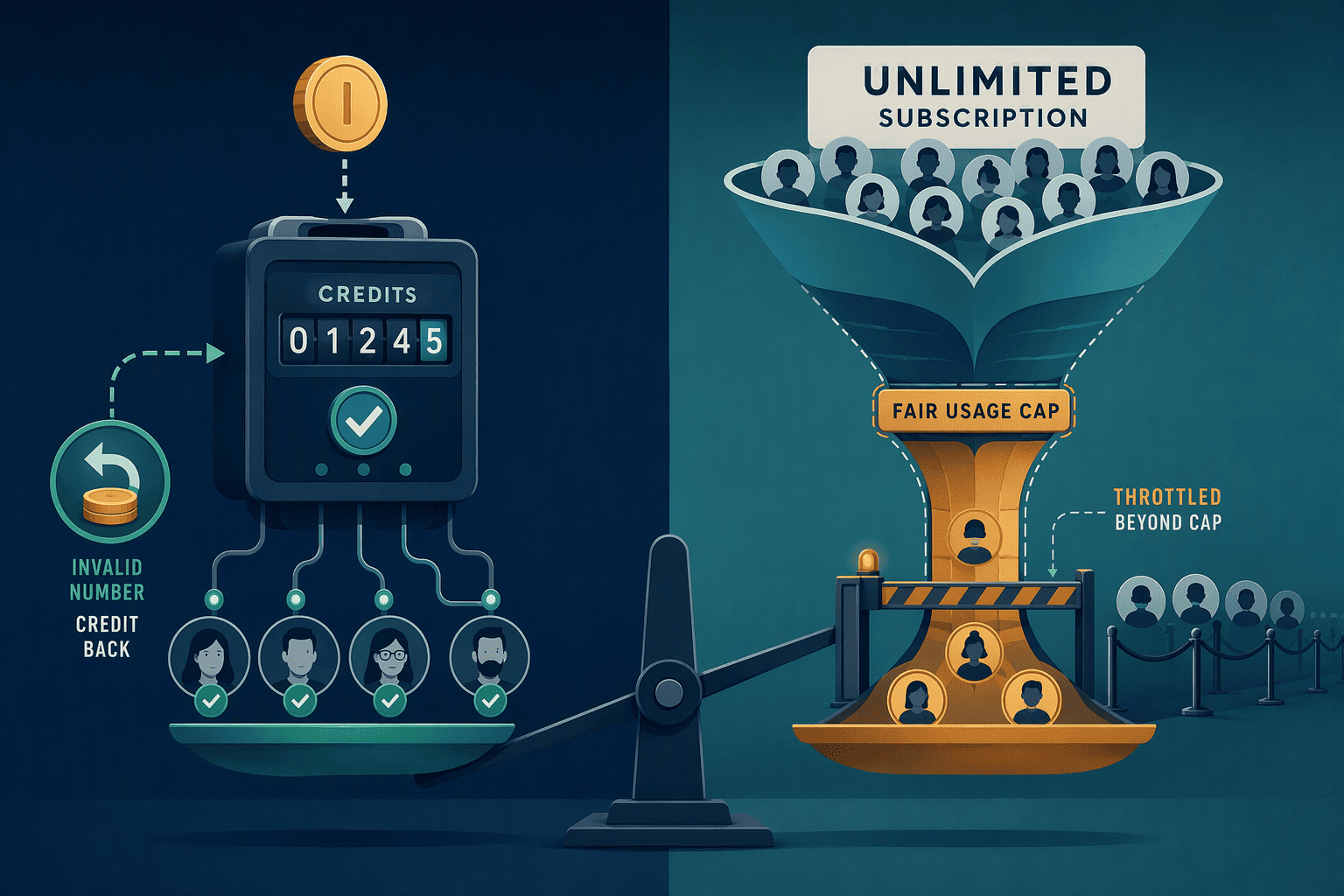
Credit-based pricing gives you granular control. Pay per verified contact, top-up instantly when you need more, and never pay for a bounced email. PeakAi's model starts at $9 for 50 contacts with a credit-back guarantee on incorrect numbers.
Subscription plans that advertise "unlimited" contacts almost never are. Fair usage policies typically cap extraction at 500 to 1,000 contacts per month. Once you hit the cap, throttling kicks in or enrichment stops entirely.
This hidden cost trap catches Indian teams that scale up without auditing per-contact economics. A subscription plan priced at $49 per user per month with a 1,000-contact fair usage cap costs roughly $0.049 per contact if you hit the ceiling. PeakAi charges a transparent $0.18 per credit where you pay only for verified contacts delivered.
The subscription charges you whether the contacts bounce or not. For Indian teams running spot-check enrichment under 500 profiles monthly, credit-based models typically deliver better cost-per-verified-contact outcomes.
For high-volume teams, the breakeven math depends entirely on the platform's India-specific accuracy rate. Every percentage point of verification failure under a subscription cap is wasted spend you cannot recover.
Credit-based plans also avoid the expiry problem. Purchased credits on platforms like Reo.Dev never expire, letting you bank them for future campaigns. Subscription credits, in contrast, typically reset monthly, so unused capacity is lost. Indian sales leaders should calculate cost-per-verified-contact, total spend divided by live contacts that actually connect, not cost-per-credit or cost-per-seat.
Conclusion
India's contact data reality does not reward generic accuracy claims. Dual-validation, compliance-first enrichment, and pricing models that charge only for verified contacts are what move the needle. PeakAi's India-first architecture applies the verification signals that actually predict Indian contact validity: GST cross-referencing, mobile carrier lookup, job-tenure monitoring, and deliverability testing.
Before selecting any LinkedIn contact discovery platform for your 2026 pipeline, reduce every tool to a single metric: accuracy per rupee. Run a 50-contact test batch across three platforms and measure verified connects. The tool that wins on that number is the only one worth your budget.
Frequently Asked Questions
What defines a truly accurate contact discovery platform for LinkedIn, and why do advertised accuracy percentages often mislead?
True accuracy means verified email deliverability and direct-dial phone connectivity, not syntax validation. Advertised percentages like 85 to 95% often measure format checks that never confirm whether an email reaches an inbox. In India, real-world find rates drop by 30 to 40% against those claims.
How does PeakAi's India-first verification and dual-validation process compare to global platforms like Apollo.io, Lusha, or Hunter for Indian-market accuracy?
PeakAi runs two verification passes: first against GST registration and MCA databases, then against active telecom sources. Global platforms use single-pass or third-party-only checks. Apollo.io's 95% global claim falls to roughly 50 to 53% direct-dial accuracy on Indian numbers, while PeakAi's dual-validation maintains 85 to 90% verified Indian accuracy.
What is the step-by-step methodology for evaluating a LinkedIn contact tool's compliance risk, real-world accuracy, and pay-per-use cost-effectiveness in 2026?
Define India-specific accuracy metrics focused on deliverability. Build a 50 to 100 contact test list spanning cities and seniority levels. Run parallel trials across three platforms. Measure actual delivered emails and connected calls. Calculate cost-per-verified-contact by dividing total spend by live contacts that connect.
Which contact discovery platforms offer verifiable direct-dial phone and verified email accuracy in India without violating LinkedIn's Terms of Service?
Enrichment-based platforms like PeakAi, Kaspr, and Evaboot query third-party databases and public registries rather than scraping live LinkedIn profiles. This architecture generally complies with LinkedIn ToS. Scraping-based tools that extract data from profile fields expose accounts to suspension risk.
What are the key pricing models (credit-based vs subscription) for contact finders, and how do fair usage policies impact unlimited plans for Indian sales teams?
Credit-based models charge per verified contact with transparent per-unit cost and instant top-up. Subscription unlimited plans include fair usage caps of 500 to 1,000 contacts monthly before throttling, effectively creating a hard ceiling that makes per-contact costs rise sharply when overage is blocked.
How do enrichment-based tools using third-party databases differ from scraping-based tools in LinkedIn compliance, and what verification methods like confidence signaling and GST cross-referencing matter?
Enrichment tools pull from business registries, GST databases, and telecom records without touching LinkedIn's interface. Scraping tools harvest live profile data, violating ToS. Confidence scoring signals verification strength without guaranteeing outcomes. GST cross-referencing confirms active Indian entity registration, providing a compliance-safe validation layer.
Sources
- Best Linkedin Email Finder Tools in 2026 - www.folk.app
- Reo.Dev Credit-Based Pricing: FAQs - docs.reo.dev