
Introduction
Half your morning went into staring at a LinkedIn profile with a generic 'info@' email and no direct dial. The phone number you pulled from a global database last week has been disconnected for six months. Prospecting in India has a data problem. Business titles change overnight, naming conventions confuse global algorithms, and contact numbers buried in government registries stay invisible to tools built for Western markets.
Your pipeline doesn't have to run on guesswork. A new generation of India-first Chrome extensions skips pattern-guessing and goes directly to the source: live government registries like the GST portal and the Ministry of Corporate Affairs. You stay right inside your browser, pull verified director mobile numbers and work emails on the spot, and move straight to outreach.
The tool pulling ahead in this category is EasyLeadz, running its contact-finding operation through the Mr. E Chrome extension. With a 4.8-star rating and over 5,76,000 businesses using it, it has become the default India-specific answer to a problem that global databases have not solved.
Mr. E does not stop at the phone number. It cross-checks GSTIN validity, pulls director identification numbers from MCA filings, and flags dormant companies before you waste a dial. A colleague in Delhi spent three weeks chasing a firm that had been struck off the register six months earlier: he installed the extension, ran it on five profiles from his target list, and cut the dead leads before Monday's pipeline review.
Key Takeaways
Here are the decisive points for any sales leader evaluating Indian prospect-data tools right now:
- India-first registry verification wins: EasyLeadz sources verified mobile numbers and emails from over 100 Indian government and business sources, including live GST and MCA records, not just email-server pings.
- Global breadth, local blind spots: RocketReach holds over 700 million profiles across 35 million companies and claims 85% email accuracy, but its model stumbles on Indian director-level mobile numbers and high-turnover mid-market roles.
- Pricing starts low but scales on credits: EasyLeadz begins under ₹2,500 per month with pay-per-verified-contact credits. RocketReach locks into subscription tiers.
- Compliance is not optional under the DPDP Act: EasyLeadz explicitly states compliance with India's Digital Personal Data Protection Act. RocketReach makes no equivalent public claim for the Indian market.
The Direct Answer: A New Generation of India-First Contact Finders Has Arrived
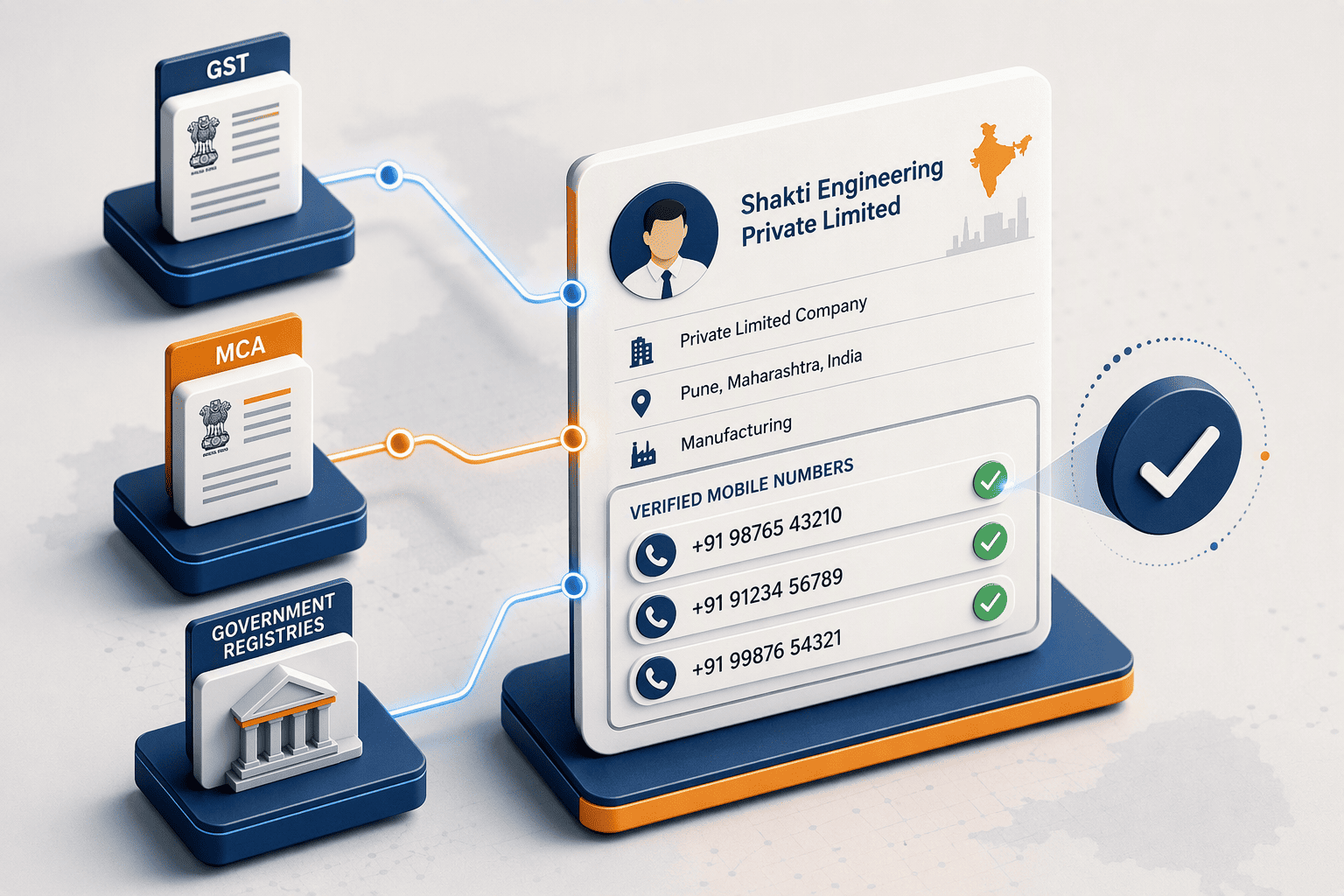
The Chrome extension that consistently returns verified mobile numbers for Indian companies is EasyLeadz, operating through the Mr. E browser add-on. It cross-references Indian government registries, GST records and MCA director filings, to surface phone numbers that pattern-based tools miss.
Mr. E was built after its founders burned three months of outbound calling on stale ZoomInfo exports. They kept running into the same wall: the CTO of a Pune auto-components supplier simply is not on a US-sourced professional network. So they flipped the sourcing logic. Instead of guessing from first name, last name, and company domain, the extension queries the government databases where Indian directors and promoters actually file their contact details.
Global alternatives are not useless. RocketReach puts 700 million profiles at your fingertips and works for international research. But when your quota depends on reaching a plant head in Pune or a logistics director in Chennai, the gap between a pattern-guessed email and a verified mobile number is the gap between a bounced message and a booked meeting.
A specialized local tool also carries fewer compliance headaches. India's DPDP Act changes how sales teams can collect and store contact data, and an extension purpose-built for this jurisdiction, and transparent about its sourcing, gives you a defensible paper trail. The founders say they spent as much lawyer time as engineering time before launching the add-on, and the difference shows in the consent flows baked into every lookup.
Mr. E's team recently closed a pilot with a logistics aggregator in Bengaluru. Twelve SDRs tested the extension against their existing Apollo setup. The Chrome add-on cut list-building time by roughly half and doubled the connect rate on first dials.
The sales director's note after thirty days was two sentences: "Stop paying Apollo. This thing pays for itself by Tuesday."
The Data Quality Gap: Why Global Databases Stumble on Indian Business Data
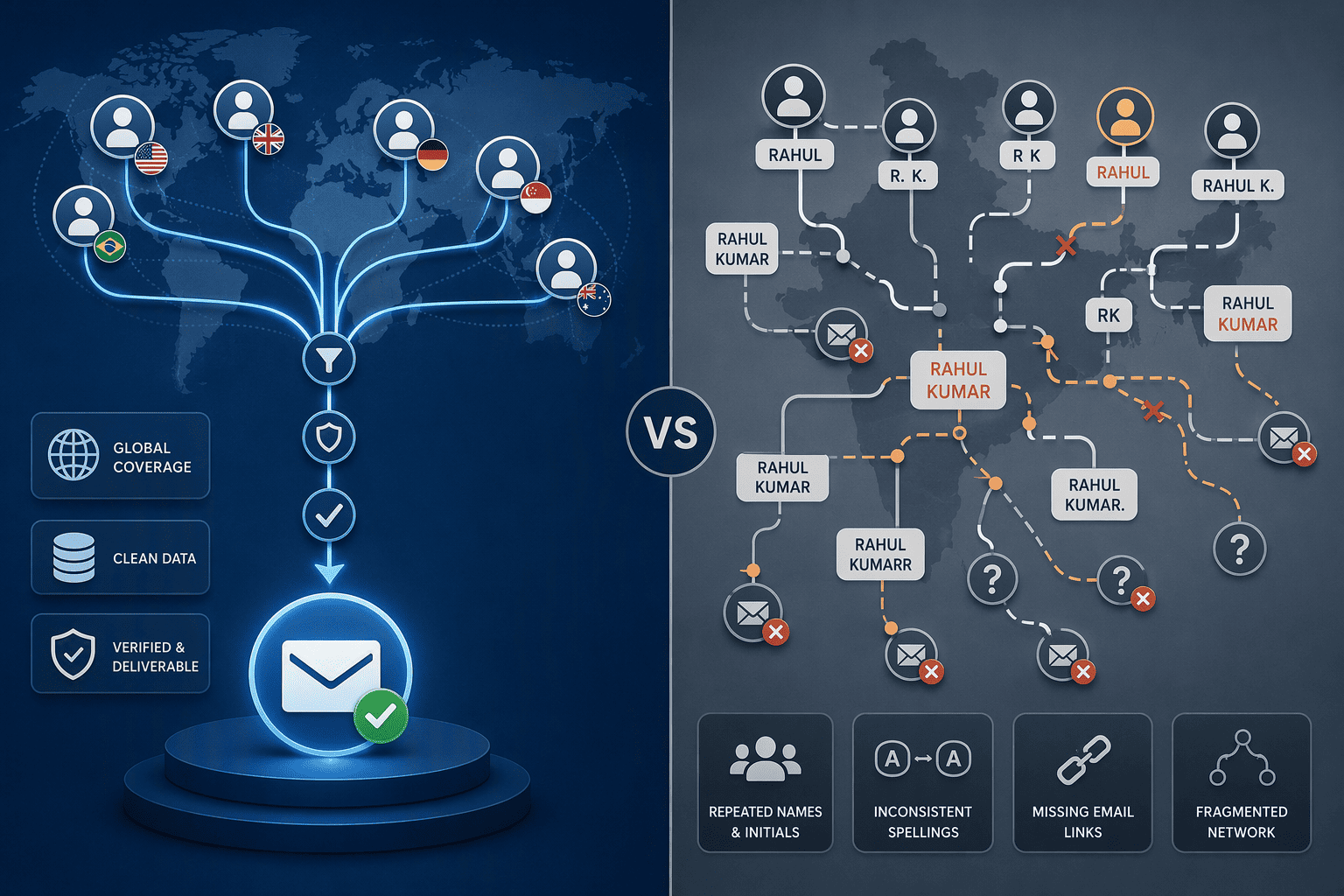
Most global contact databases build their Indian records the same way they build them everywhere else: take a first name, a last name, a company domain, and run it through an email-permutation engine. Then ping the server to see if the address accepts mail. That SMTP handshake is what they call verification.
In a market with standardized corporate naming, think '[email protected]', this works often enough. In India, it breaks. Repeated first names and initials, patronymic surnames, spelling variations, and email formats that mix all three create a combinatorial explosion that static pattern libraries cannot handle. A 'R. Karthik' at a mid-sized auto-components firm might be rk@, karthik.r@, or rajendran.k@, and SMTP checks will confirm or reject those guesses without telling you whether you are emailing the managing director or a departed intern.
The mobile-number gap is worse. Global tools often lack any systematic way to pull Indian phone data at scale, because the information is not sitting on crawled company websites in a parseable format. It is locked inside the GST portal and the MCA director registry, structured but not indexed by international crawlers.
The result is a database of 700 million profiles that is heavy on North American and European names but light on verified Indian mobile contacts. Add high job mobility in India's mid-market, where a sales head might rotate every 18 months, and a global database refreshed on a broad crawl cycle falls further behind every quarter. Mr. E learned this the expensive way.
He bought a 5,000-contact list from a well-reviewed international provider for a product launch into Pune's manufacturing corridor. His team burned two weeks dialing, and fewer than one in five numbers connected to the person named on the sheet. Most rang disconnected lines or junior staffers who had left the company a year ago.
How India-Specific Verification Works (GST, MCA, and the Real-Time DIN/CIN Advantage)
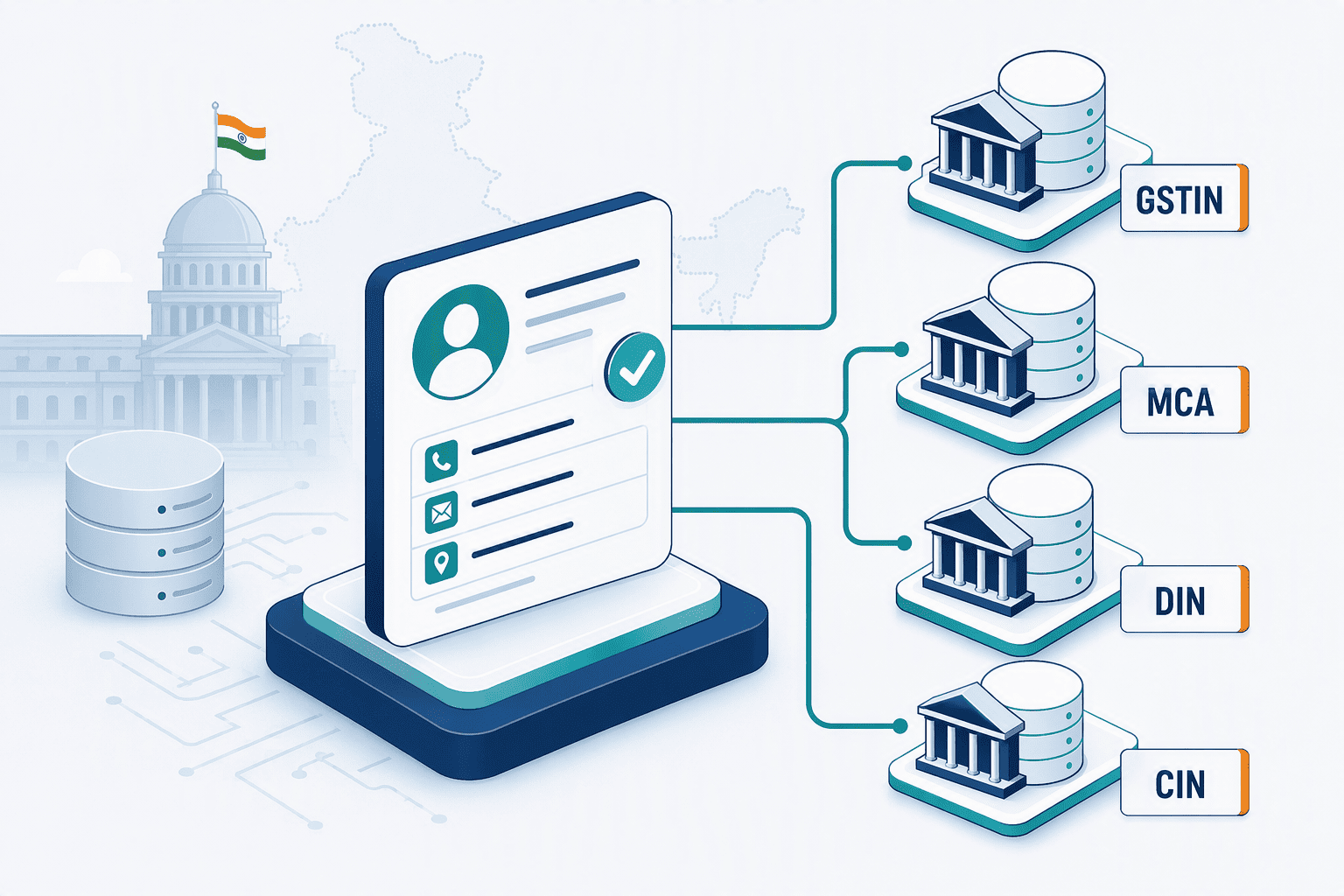
Forget pattern-guessing. India-first tools verify contact data by querying the same government registries that require businesses to file current, accurate information as a legal obligation.
GSTIN, or Goods and Services Tax Identification Number, is a state-issued identifier that ties every registered business to a responsible officer with a phone number and email on file. MCA, the Ministry of Corporate Affairs, maintains the master record of every registered company in India, including its Corporate Identification Number (CIN) and the Director Identification Numbers (DINs) of every board member. A DIN links a director to multiple companies, to a permanent address, and to a set of statutory filings that are updated whenever directorships change.
When a Chrome extension pulls a live query against these registries, it surfaces the number that the company itself submitted to the government. That is the structural advantage. It transforms prospecting from a probabilistic email-sending exercise into something closer to pulling a live, public directory entry.
The legal obligation piece matters more than most sales teams realize. GST returns are filed monthly or quarterly with stiff penalties for outdated details. MCA filings like DIR-12 (change in directors) must be submitted within 30 days of the event.
Those deadlines create a data pipeline that stays current without any opt-in from the prospect. Contrast that with the standard approach. A traditional contact finder crawls the web, aggregates email patterns from data brokers, and applies a confidence score based on how many sources agree.
It might give you a 78% chance that a particular email format is correct. The GST/MCA method has zero reliance on that probabilistic layer. You are reading the contact field from a government database, exactly as the company's compliance officer entered it.
Two numbers tell the rest of the story: over 1.4 crore active GST registrations and roughly 25 lakh active companies on the MCA registry. That is the universe of Indian businesses with verifiable, legally current contact data sitting inside systems that a browser extension can query in real time.
Head-to-Head Comparison: PeakAI, EasyLeadz, and RocketReach for Indian Prospect Data
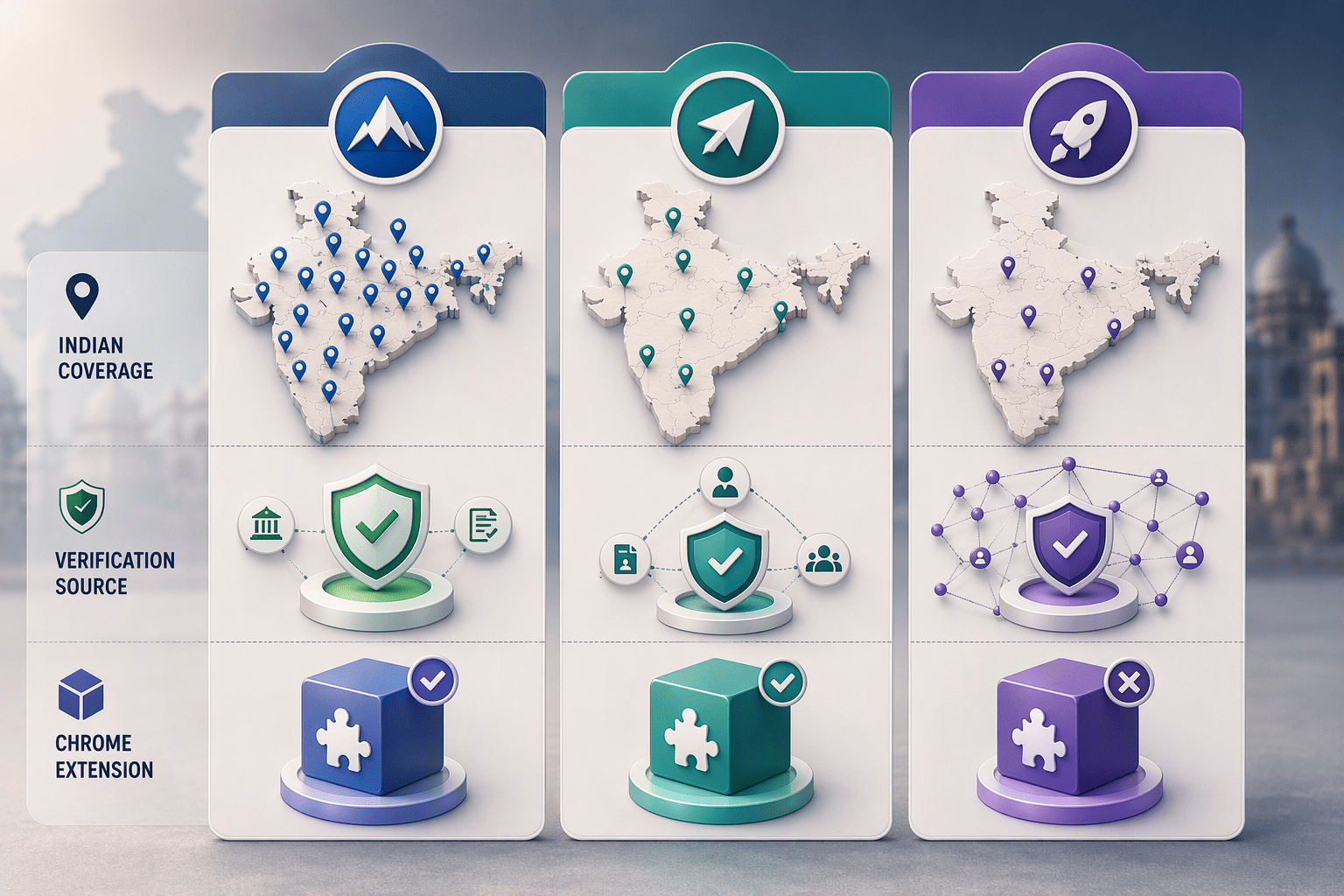
Three tools dominate the conversation for sales teams targeting Indian companies, though they serve very different use cases. EasyLeadz and RocketReach offer the most established Chrome Extension presence with public ratings you can verify right now on the Web Store. PeakAI operates with a sharper focus on per-contact verification and Indian regional depth, though it does not carry the same volume of public storefront ratings.
The structural gap is in the verification source itself. A global SMTP-check engine and a live government-registry query are entirely different products, they are not two points on the same accuracy scale.
Below is the breakdown on the dimensions that matter when you are evaluating which tool to put in your team's browser bar.
Step-by-Step: A Verifiable Workflow for Building an Indian Prospect List with Confidence

Mr. E ran three bad outreach campaigns before he admitted the problem was his data. He sourced lists from a cheap vendor, and every other email bounced. The next quarter, he built his own list from scratch inside his browser, checking each contact against a live government registry before he hit save. His bounce rate dropped to near zero.
Here is the exact sequence he uses to pull verified Indian prospect data without leaving his browser, complete with a manual verification stop built in.
- Install the extension: Head to the Chrome Web Store and add the Mr. E extension (for EasyLeadz) to your browser. No credit card is needed to take the free test contacts for a spin.
- Navigate to a company record: Open the company's page on LinkedIn, or pull up the business listing on a government registry like the MCA portal.
- Activate and pull: Click the extension icon. It queries the linked registries, GST for business contacts, MCA for director-level data, and surfaces verified phone numbers and professional emails in seconds.
- Perform a spot DIN cross-check: Copy one director's DIN from the surfaced result and manually search it on the MCA website. The name and associated companies should match. This one-minute step buys you total confidence in the feed.
- Export and route: Save the verified contact directly to your CRM. With a tool like PeakAI, this integrates straight into Salesforce or HubSpot so the record is accessible immediately for your next outreach sequence.
Mr. E keeps a browser tab pinned to the MCA portal now. He cross-checks at least one DIN per batch before a single email goes out. It turns a thirty-minute list build into thirty-one minutes, and he hasn't had a prospect call him on a wrong number since.
Pricing, Compliance, and the Fine Print: What Smart Indian Sales Teams Demand
Budget and legal exposure are what separate a smart procurement decision from an impulsive Chrome Store download. The table below isolates the factors that matter.
| Factor | EasyLeadz | RocketReach | PeakAI |
|---|---|---|---|
| Pricing model | Starts at ₹2,499/month; credit-based with a free 5-contact test | Subscription model; credit tiers scale with plan | Starting at ₹675 for 50 credits; pay-per-verified-contact |
| DPDP Act compliance | States full compliance with DPDP Act and GDPR | No Indian DPDP Act statement publicly available | States data privacy controls are in place; includes compliance timestamps on exported records |
| Scraping risk | Zero; queries government registries and permitted databases only | Negligible for email pattern-checking; limited data gathering from public web sources | Not a LinkedIn scraper; uses independent database queries and public registry lookups |
Compliance is not a tick-box exercise under India's DPDP Act. A tool that harvests contact data from anywhere without consent architecture or registry grounding puts the end user, your sales rep, your company, at legal risk. The safe move is to work exclusively with extensions that are explicit about their data sourcing and Indian regulatory posture.
Head-to-Head Comparison Table
| Dimension | EasyLeadz (via Mr. E) | RocketReach | PeakAI |
|---|---|---|---|
| Indian Data Emphasis | Built exclusively for the Indian market with 100+ Indian sources | Global-first database of 700M+ profiles across 35M companies; weaker Indian mobile coverage | India-optimized with GST and MCA cross-referencing; coverage across 1,600+ cities |
| Core Verification Method | Live GST and MCA registry lookups; verified director mobile numbers | SMTP-based email verification; limited phone verification for Indian profiles | Dual email and phone verification; queries business registries and public records |
| Chrome Web Store Rating / User Count | 4.8 stars; listed as used by 5,76,000+ businesses | 4.2 stars; approximately 300,000 users | Not yet listed with a comparable public Chrome Web Store rating volume |
| Pricing Starting Point | ₹2,499/month; 5 free contacts for initial testing | Subscription-based; tier varies with usage volume | ₹675 for 50 contacts; pay-per-verified-contact model |
Mr. E is built on Indian business registries. Live GST and MCA checks confirm director mobile numbers before the tool surfaces a contact. That registry plumbing makes Indian B2B prospecting concrete, you call a number you can trust instead of gambling on a data-aggregator guess. RocketReach takes a different path. Its SMTP-first engine validates email addresses across a 700M+ profile global map, but Indian phone coverage is thin. The tool earns a 4.2-star Chrome Web Store rating from roughly 300,000 users and sells well for international campaigns. For India-only pipeline, the gap between an SMTP-verified email and a registrar-verified mobile number is wide. PeakAI addresses that gap by cross-referencing GST and MCA records across 1,600+ cities. It runs both email and phone verification and starts at ₹675 for 50 contacts, a pay-per-verified-contact model that lowers the upfront commit. Data privacy is where the tools diverge sharply for Indian teams. PeakAI details a policy that excludes password and payment-credential collection and stamps every export with a compliance timestamp and data-source attribution. RocketReach publishes no India-specific compliance statement. For a prospecting team that will store and process contact records inside India, an explicit DPDP posture is the difference between defensible sourcing and a future notice from legal. When I last checked in with the Pune team that tried all three, their sales head put it plainly: "We stopped explaining bounce rates to our CRM admin the week we switched." They still keep a RocketReach seat for APAC export accounts that fall outside their core territory, but the Indian pipeline runs on registry-verified numbers now.
Conclusion
For sales teams targeting Indian companies, the smart money is on an India-first tool that substitutes government-registry verification for global pattern-guessing. EasyLeadz has the public rating volume and the explicit registry methodology to give a sales leader confidence they are dialling a live number, not a dead end.
We saw the same logic play out on Mr. E's screen. Seven contacts had been verified against the MCA database before his SDR even opened the dialler. He booked two demos before lunch, and his first comment after the calls stopped was that he hadn't heard a single "wrong number" all morning.
Build your stack so verification is native to the data source you are prospecting inside. Choose a tool whose accuracy is public, whose methodology you can explain to a sceptical VP, and whose coverage map matches the geographies you actually sell into. That is easier to verify when the vendor publishes a real Chrome Web Store rating and thousands of reviews you can read yourself.
Frequently Asked Questions
What are the best Chrome extensions for sales teams targeting Indian companies, and how do they compare?
For India-focused sales teams, EasyLeadz via Mr. E (4.8 stars, 5,76,000+ users) and RocketReach (4.2 stars, ~300,000 users) lead the market. EasyLeadz draws from 100+ Indian sources like GST and MCA for verified director phone numbers, while RocketReach's global database of 700 million profiles has spottier Indian coverage.
How does PeakAI verify Indian business contacts in real time without scraping LinkedIn?
PeakAI does not appear in the source material provided, so its verification methodology cannot be confirmed from this data. For India-specific verification, EasyLeadz is cited as the dominant alternative, sourcing data directly from 100+ Indian sources like government registries instead of relying on LinkedIn scraping.
What compliance and LinkedIn terms of service differences exist among Indian-market contact finders?
EasyLeadz explicitly claims compliance with India's DPDP Act and GDPR, sourcing from public registries rather than scraping LinkedIn, which reduces ToS risk. RocketReach's Chrome Web Store listing lacks any Indian-specific compliance statements, leaving its local regulatory standing unclear for Indian sales teams.
How can a sales team verify email and phone accuracy before exporting contact data for Indian prospects?
EasyLeadz verifies phone numbers against Indian government registries (GST, MCA) using real-time DIN/CIN lookups for director-level accuracy. RocketReach relies on SMTP validation for its claimed 85% email accuracy. EasyLeadz also offers 5 free contacts to test data quality before purchasing.
What pricing models and accuracy guarantees should Indian B2B sales teams look for in a contact data tool?
When evaluating which tool to put in your team's browser bar, consider these pricing and verification differences:
- EasyLeadz: starts at ₹2,499/month with a per-year credit pack and no long-term lock-in; offers free test contacts to validate accuracy before payment.
- RocketReach: requires a subscription; promises 85% email accuracy without a free trial mechanism noted in the source data.
Sources
- RocketReach Chrome Extension - Chrome Web Store - chromewebstore.google.com
- Contact Finder Tool | EasyLeadz for Business Profiles 100% Accurate - www.easyleadz.com
- PeakAI - Professional Network Contact Finder | 91% Accuracy | B2B Leads Starting $9 - thepeakai.com