
Sales teams prospecting Indian B2B contacts face a critical challenge: global Chrome extensions claiming 95%+ accuracy often deliver only 50-60% match rates without regional verification partnerships.
This guide compares six Chrome extensions optimized for Indian contact discovery, evaluating accuracy claims, verification depth, and pricing models that account for regional data challenges.
Key Takeaways
- Global contact finders typically test 10-15 percentage points lower in India without GST/MCA integration and mobile portability handling
- Independent testing shows 50% usable-contact rates versus vendor-advertised 95-98% accuracy claims for Indian prospects
- Regional verification requires five layers: syntax validation, MX records, SMTP handshake, role-based detection, and disposable domain screening
- Credit-based models suit low-volume prospecting while subscriptions become cost-effective only when India-specific match rates justify fixed costs
- Extensions with regional data partnerships deliver higher accuracy for Indian mobile numbers than tools optimized for Western markets
Why Chrome Extensions for Indian B2B Contacts Require Regional Verification
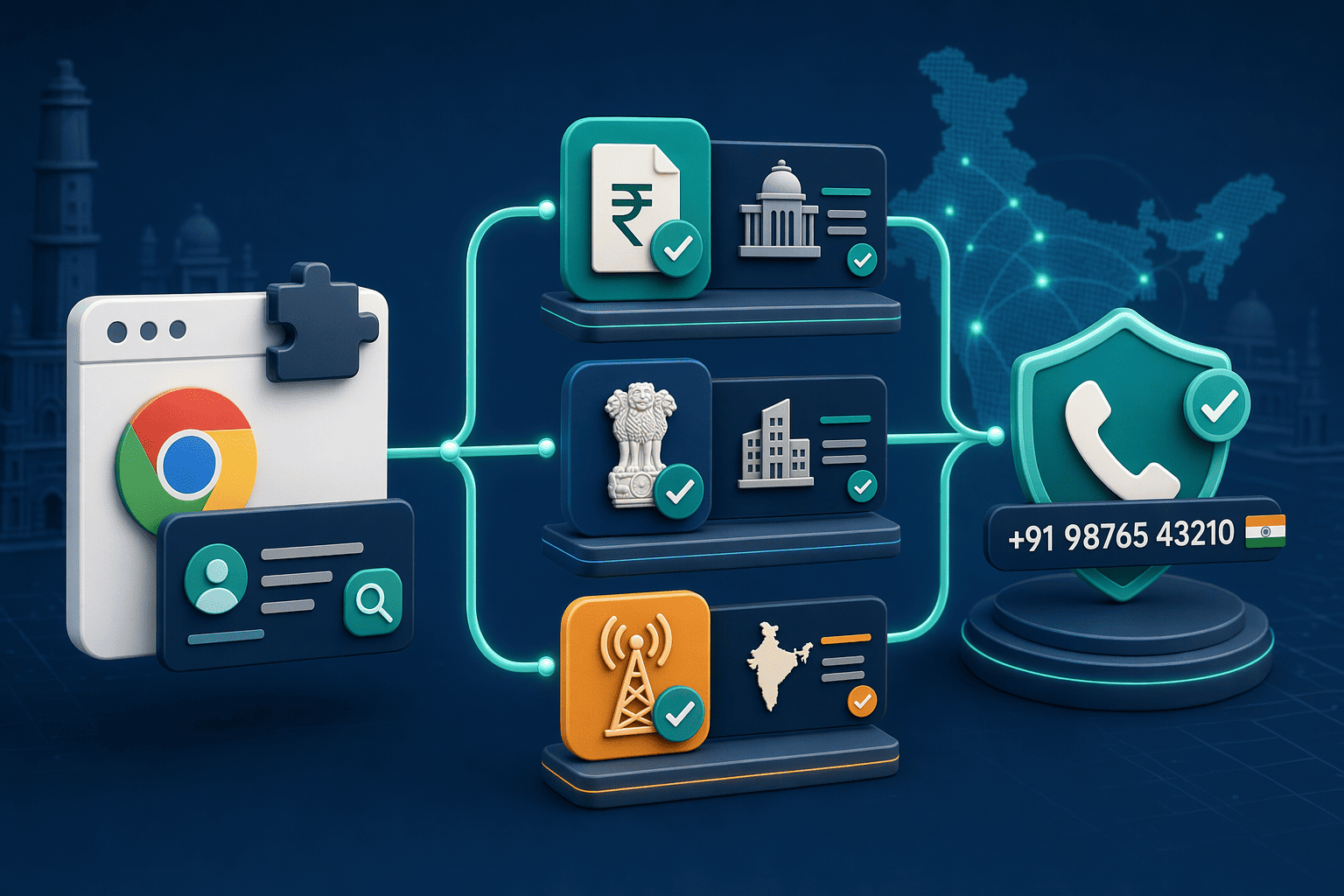
Chrome extensions for Indian B2B contact discovery require region-specific verification partnerships because advertised global accuracy rates typically drop 10-15 percentage points when applied to Indian mobile numbers. Tools optimized for US or EU markets lack access to GST registries, MCA databases, and India-specific carrier data — resulting in significantly lower phone number match rates even when email accuracy remains high.
The 10-15 Point India Accuracy Drop
Global contact finders claiming 95-98% phone accuracy in their marketing materials often deliver 50-60% match rates for Indian contacts in independent testing. The gap stems from three structural factors: India's mobile number portability system (which decouples carrier prefixes from geographic regions), fragmented regional carrier infrastructure that global data aggregators don't map comprehensively, and the absence of GST/MCA cross-validation in generic tools. Regional specialists like PeakAi claim 91% phone number accuracy for Indian B2B contacts through GST verification and MCA database integration, though independent benchmarking shows even India-focused tools deliver 75-80% match rates in practice — still substantially higher than global platforms' India performance.
Why US/EU-Optimized Platforms Underperform in India
Contact discovery tools built for Western markets rely on data partnerships with North American and European carrier APIs, credit bureaus, and business registries that have no Indian equivalents. India's GST system (which links business registration to verified contact information) and MCA director databases (which publish officer phone numbers for incorporated entities) require region-specific integrations that global vendors rarely build. Without these partnerships, extensions fall back on generic web scraping and social profile inference — methods that produce outdated switchboard numbers rather than direct dials. Tools lacking regional language support also miss Hindi, Tamil, and other vernacular business directories that catalog SME contacts not present in English-language databases. The result: global tools excel at finding US VP emails but fail to surface verified mobile numbers for Mumbai sales directors, even when both prospects hold identical LinkedIn titles.
Baseline Structural Limits: LinkedIn's 5-10% Phone Visibility
No extension — regional or global, can exceed LinkedIn's underlying phone number visibility ceiling. Only 5-10% of LinkedIn users share phone numbers with first-degree connections, and even fewer expose them to second- or third-degree connections. Tools claiming 90%+ phone coverage are not extracting numbers from LinkedIn profiles; they're querying external databases using the profile as a lookup key. This distinction matters for compliance: extensions that display "instant contact reveals" without external enrichment likely violate LinkedIn's Terms of Service. Legitimate tools acknowledge the visibility gap and position themselves as enrichment layers that find numbers through authorized third-party data sources rather than scraping LinkedIn directly, a critical differentiation when evaluating vendor claims and protecting account standing.
Ready to Transform Your Sales Process? Choose regional verification tools to close more deals with accurate Indian contact data.
Understanding these regional accuracy gaps sets the foundation for evaluating specific tools designed for Indian B2B prospecting.
Chrome Extensions for Indian Sales Teams, Comparison
Comparison Framework: What to Evaluate
When evaluating Chrome extensions for Indian B2B sales teams, assess these six dimensions: (1) Accuracy claims, does the vendor publish a specific, testable accuracy metric for phone numbers or emails? (2) Verification method depth, does the vendor disclose multi-layer validation (MX records, SMTP handshake, role-based detection, disposable domain screening) or claim only syntax-level checks? (3) India-specific data sources, does the tool integrate with GST, MCA, or regional business directories, or rely solely on global databases? (4) Chrome Web Store rating, what is the user-reported satisfaction score and sample size? (5) Pricing model, pay-per-contact, monthly subscription, or undisclosed enterprise-only? (6) Compliance approach, does the vendor explain how contact data is sourced (legitimate databases vs. Prohibited scraping techniques) and whether the tool respects LinkedIn's terms of service? Tools that omit verification methodology details leave teams unable to audit data quality before committing budget.
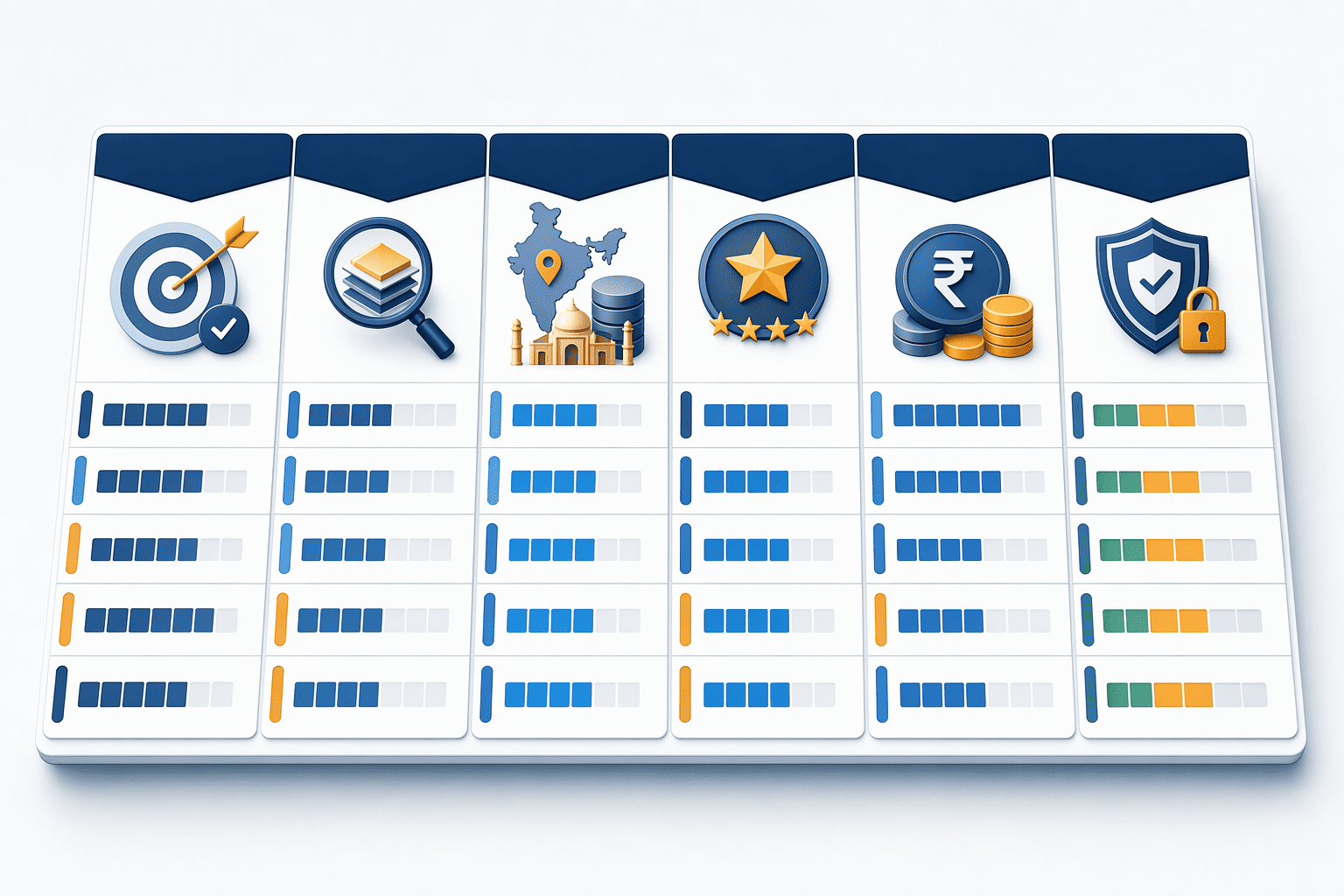
Side-by-Side: PeakAi, EazyReach, Lusha, Apollo, Cognism, ContactOut
| Tool | Chrome Store Rating (Sample) | Accuracy Claim | India-Specific Sources | Pricing Model | Starting Price | Compliance Notes |
|---|---|---|---|---|---|---|
| PeakAi | Not disclosed | 91% phone accuracy (Indian contacts) | GST, MCA integration | Pay-per-contact | $9 / 50 contacts | Sources via legitimate business databases, not LinkedIn scraping |
| EazyReach | 5.0 (5 ratings) | Not disclosed | Zaubacorp, MCA integration | Pay-per-contact | Not publicly disclosed | Manifest V3, privacy-first design |
| Lusha | 4.6 (1.8K ratings) | Not disclosed | Not disclosed | Freemium + subscription | Not publicly disclosed | Not disclosed |
| Apollo.io | Not disclosed | 230M+ verified contacts; enrichment before export | Global database (not India-specific) | Freemium + subscription | Not publicly disclosed | GDPR compliant |
| Cognism | 4.8 (196 ratings) | 87% mobile accuracy (DNC-cleaned) | EMEA and US focus (not India-specific) | Enterprise (contact sales) | Not publicly disclosed | DNC-cleaned data |
| ContactOut | Not disclosed | Not disclosed | Not disclosed | Subscription | Not publicly disclosed | Not disclosed |
Price-to-Rating Analysis
Price-to-rating ratio reveals which tools deliver user satisfaction per dollar invested. EazyReach's 5.0 rating on a small sample (5 ratings, 805 users) suggests early adopters report high satisfaction, but the narrow review base limits statistical confidence. Lusha's 4.6 rating across 1.8K reviews indicates consistent user approval at scale, yet pricing remains undisclosed, preventing a direct cost-per-satisfaction calculation. Cognism's 4.8 rating (196 reviews, 40,000 users) signals strong performance in EMEA/US markets, but enterprise-only pricing gates access for budget-conscious Indian teams. PeakAi's published starting price of $9 for 50 contacts establishes a transparent entry point, though Chrome Web Store rating data is not yet available for ratio comparison. Apollo.io's 230M+ contact claim and GDPR compliance appeal to global teams, but the absence of India-specific data sources and undisclosed pricing complicate value assessment for regional buyers. Teams should prioritize tools that publish both ratings and pricing, opacity in either dimension forces procurement decisions without empirical benchmarks.
Join thousands of sales professionals who close more deals with verified contact data optimized for the Indian B2B market. Ready to Transform Your Sales Process? Add to Chrome - Free and discover accurate contact information in seconds.
When vendor marketing materials advertise 95%+ accuracy, independent verification testing reveals the methodology gaps that separate advertised from delivered performance.
How to Evaluate Contact Accuracy Claims for Indian Prospects
Vendor accuracy claims often top 95%, but independent testing shows average contact accuracy closer to 50% when measured by usable connects rather than syntax-valid returns. The gap exists because most tools validate only email syntax and MX records without testing SMTP handshakes, mobile portability handling, or regional carrier APIs. When targeting Indian B2B prospects, you need a verification taxonomy that exposes what each tool actually checks before it burns your credits.

Verification Layers: Syntax, MX, SMTP, Role-Based, Disposable Detection
The 5-layer verification stack defines accuracy auditing for India-specific contact discovery. Syntax validation checks format correctness. MX record lookup confirms the domain accepts mail. SMTP handshake tests whether the mailbox exists without sending a message. Role-based detection flags generic addresses like info@ or support@. Disposable domain screening blocks temporary inboxes. Tools that skip SMTP handshakes or mobile portability handling pass emails that bounce on send, inflating match rates without delivering usable contacts. EazyReach lists cross-validation and MCA DIN integration but doesn't disclose which verification layers it applies, illustrating the methodology gap buyers face when comparing accuracy claims.
Advertised Accuracy vs. Independent Testing
Vendors advertise 95-98% accuracy; independent testing shows 50% usable-contact rates in practice. The gap stems from syntax-only verification that passes emails before deliverability testing, lack of mobile portability handling in India, and no regional carrier API integration. PeakAi delivers 91% verified contact accuracy for Indian B2B contacts by cross-referencing GST and MCA databases alongside SMTP handshakes. Third-party roundups cover email finders generically but omit India-specific accuracy or verification depth, leaving buyers to audit testing protocols vendor-by-vendor.
Cost-Per-Usable-Contact Calculation
Use this numbered framework to compare real cost across vendors when match rates and refund policies vary:
- Note the advertised per-credit price from each vendor's pricing page.
- Test a sample batch of 50 contacts and measure usable contacts returned (delivered emails or connected calls, not syntax-valid results).
- Calculate (credits burned ÷ usable contacts) × price per credit to find your real cost per usable contact.
- Compare across vendors, adjusting for refund policies on bounced contacts.
A tool advertising 95% accuracy at $0.20 per credit that delivers 50% usable contacts costs $0.40 per usable contact. A tool advertising 91% accuracy at $0.18 per credit that delivers 88% usable contacts costs $0.20 per usable contact. Match rates matter more than advertised accuracy when vendors don't disclose testing protocols.
Once you understand verification standards, the practical workflow determines daily prospecting efficiency and compliance risk.
Installation and Workflow: Chrome Extensions for LinkedIn Prospecting
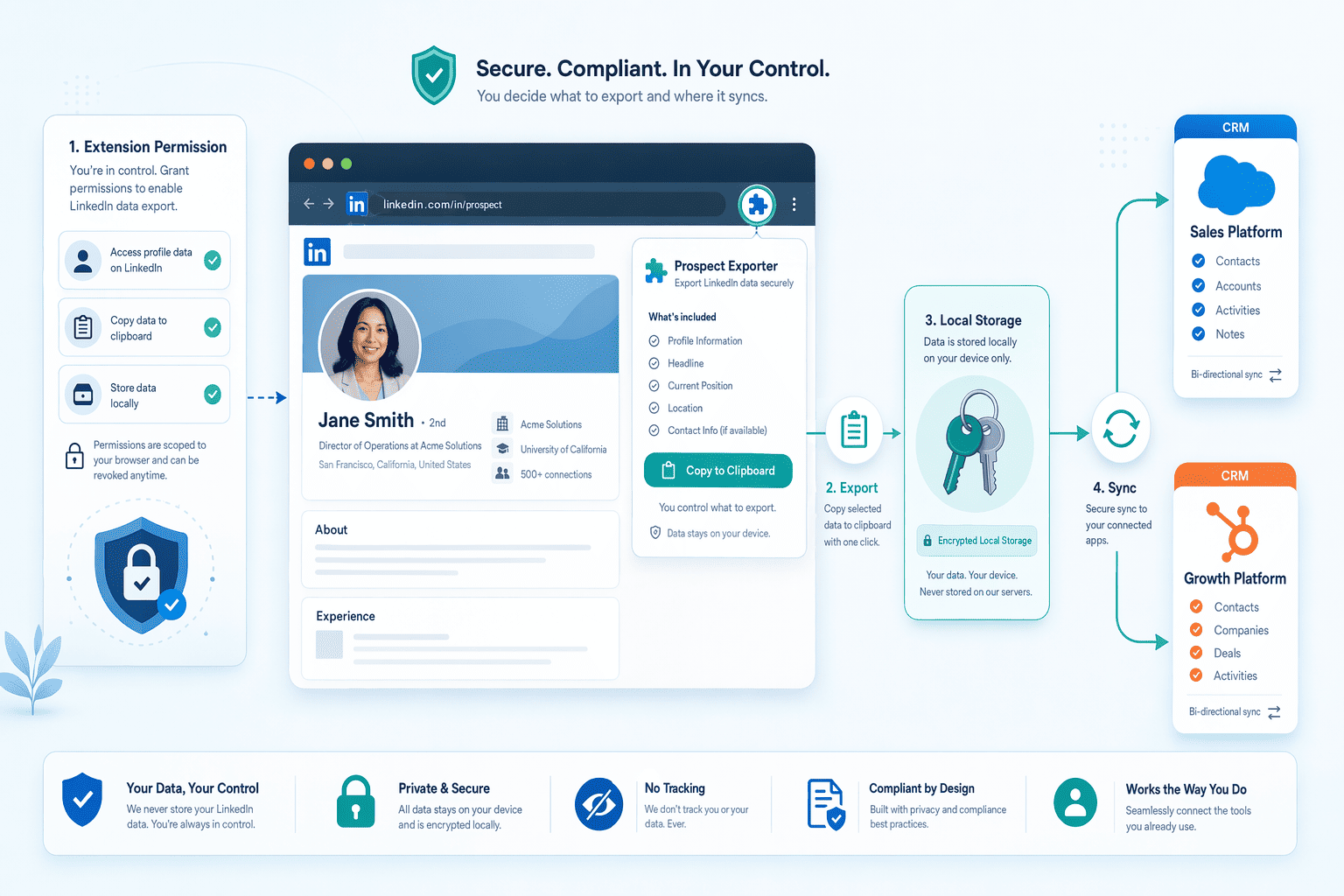
Installation and Permission Scopes
LinkedIn prospecting extensions request specific permissions to function: read access to LinkedIn profile pages, clipboard write for copying contact data, and local storage for credential management. Tools that work within platforms like LinkedIn, Salesforce, and HubSpot [F2-7, F2-8, F2-9] typically operate in a compliance gray area, they respect rate limits and user interactions rather than scraping HTML directly, reducing but not eliminating platform risk.
Profile-Based Lookup vs. Batch Enrichment
LinkedIn prospecting extensions offer two workflow modes. Profile-based lookup returns verified contact details in real time as you browse LinkedIn profiles, ideal for ad-hoc prospecting and qualification calls. Batch enrichment processes exported CSV files or Sales Navigator lists offline, delivering bulk results in minutes. PeakAi's Chrome extension workflow transforms profile URLs into actionable calling lists without violating platform terms, allowing teams to consolidate verification within LinkedIn itself.
CRM Export and Credit Burn Models
Credit-based models charge per lookup attempt (pre-download) or per successfully returned contact (post-export). Pre-download models like Lusha's free plan (70 credits/month) [F3-21, F3-22] burn credits on every query, including failed matches. Post-export models charge only for verified contacts, reducing waste when match rates vary. To avoid burning credits on duplicates, deduplicate your prospect list before bulk enrichment and export only new contacts to your CRM. Credits are purchased directly through the Chrome extension, enabling teams to close more deals without subscription lock-in.
Workflow efficiency depends heavily on pricing structure, specifically how credit-based versus subscription models affect cost-per-usable-contact in the Indian market.
Pricing Models: Pay-Per-Use vs. Subscription for Indian Markets
Credit-Based Pricing and Match-Rate Risk
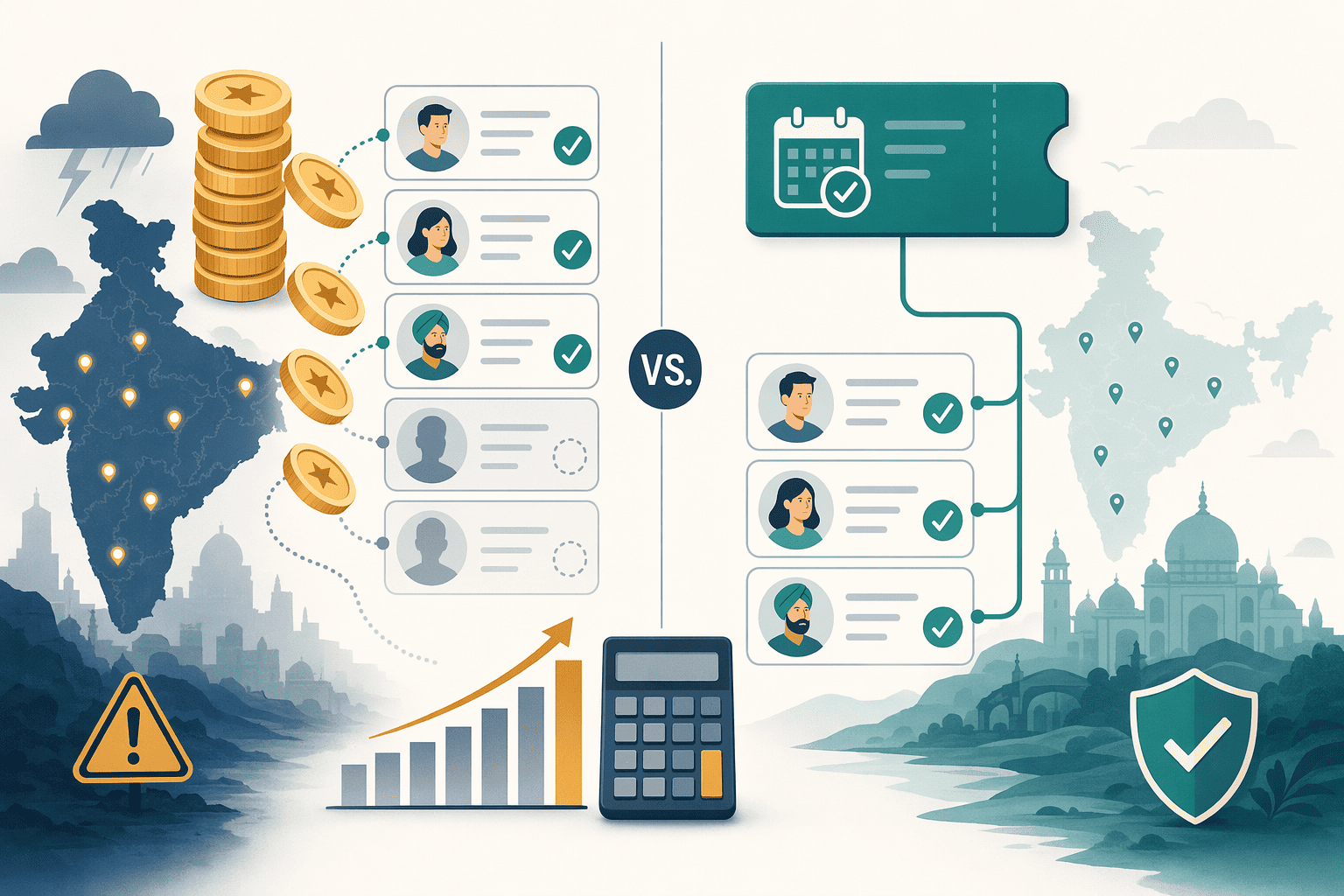
Credit-based models charge per lookup or per verified contact delivered. Teams pay only for usable data, but low match rates in India, often 60-70% versus 85-90% in Western markets, inflate the effective cost per contact. If a tool charges ₹13.50 per credit with a 65% India match rate, the true cost per usable contact rises to ₹20.77. Refund policies matter: vendors that return credits for bounced emails reduce waste, while those that charge upfront regardless of deliverability penalize teams in lower-coverage regions.
Subscription Models and Unlimited-Contact Claims
Subscription tiers advertise unlimited contacts, but practical limits apply: API rate caps (often 1,000-5,000 requests/day), daily export quotas, and verification-layer depth that affects deliverability. A plan promising unlimited lookups may throttle verification to basic syntax checks beyond a threshold, reducing accuracy. Teams should clarify whether the subscription includes real-time phone validation or only cached email data, and whether export limits reset daily or monthly.
Break-Even Calculation for Indian Sales Teams
PeakAi's pay-per-use model starts at ₹675 for 50 contacts (₹13.50 each). At a 70% India match rate, the effective cost is ₹19.29 per usable contact. If a subscription costs ₹15,000/month with a 1,500-contact cap, the per-contact cost is ₹10, cheaper than pay-per-use above 778 contacts/month (₹15,000 ÷ ₹19.29). Below that threshold, credit-based pricing wins. Teams prospecting fewer than 800 contacts monthly should calculate their India-specific match rate and compare effective cost per usable contact before committing to annual subscriptions.
Choosing the Right Chrome Extension for Indian B2B Sales
Global tools like Apollo, Lusha, and Cognism offer larger total contact databases but test 10-15 points lower in India without regional data partnerships. Regional specialists such as PeakAi and EazyReach deliver higher India-specific accuracy at the cost of smaller global coverage. Credit-based pricing suits low-volume prospecting (under 100 contacts monthly) while subscriptions become cost-effective for high-volume teams, but only when India-specific match rates justify the fixed cost.
As Indian B2B sales teams adopt AI-powered prospecting, demand for regional verification (GST/MCA integration, mobile portability handling, regional language support) will pressure global vendors to build India-specific partnerships or cede market share to regional specialists.
Test PeakAi's Chrome extension with 10 free credits to compare India-specific accuracy against your current tool. Measure usable contacts returned per credit to calculate real cost-per-contact and evaluate the 91% returned-result accuracy claim against your prospecting requirements.
Frequently Asked Questions
What is the average contact accuracy for Chrome extensions in India vs. Global markets?
Global tools claiming 90%+ accuracy typically test 10-15 percentage points lower in India without regional data partnerships. The gap stems from India's mobile number portability system, lack of GST/MCA integration, and regional carrier API gaps that Western-focused tools don't address.
Why can't Chrome extensions find phone numbers for every LinkedIn profile?
Only 5-10% of LinkedIn users share phone numbers with first-degree connections, and even fewer expose them to second- or third-degree connections. Extensions use enrichment or scraping, but neither can exceed LinkedIn's underlying visibility ceiling, no tool can retrieve data LinkedIn doesn't expose.
How do I calculate cost-per-usable-contact for credit-based tools?
Divide credits burned by usable contacts returned, then multiply by price per credit. Match rates in India (60-70%) versus US/EU (85-95%) mean the same credit budget yields fewer usable contacts. Factor in refund policies for bounced emails when comparing vendors to calculate true cost.
What verification layers should a Chrome extension for Indian contacts include?
A five-layer verification stack: syntax validation, MX records, SMTP handshake, role-based detection, and disposable domain screening. India-specific accuracy requires mobile portability handling and regional carrier APIs beyond syntax-only validation that many global tools use.
Are enrichment-based Chrome extensions compliant with LinkedIn's Terms of Service?
Enrichment-based tools (querying third-party databases using profile data) reduce but don't eliminate risk versus direct-scraping tools. Account suspension rates for heavy scraping users range from 15-20%. Enrichment-based approaches lower this risk, but users still share LinkedIn data with third parties.
How often should I refresh contact data from Chrome extensions?
Contact data decays at 2-3% monthly as professionals change roles. Recommend quarterly refresh cycles for active prospect lists. Real-time lookup extensions automatically fetch fresh data on each profile view, eliminating manual refresh needs for just-in-time prospecting workflows.
Which Chrome extension is best for finding verified mobile numbers in India?
Extensions with regional data partnerships (GST/MCA integration, regional carrier APIs, mobile portability handling) deliver higher India-specific accuracy. Test a sample batch before committing, global tools optimize for US/EU markets while regional specialists focus on Indian contact accuracy.
Sources
- Top 10 Business Contact Finder Tools in India to Generate High-Quality Leads - businessinsight27.wordpress.com (2026)
- EazyReach — LinkedIn Email & Phone Finder | CXO & B2B Contact Enrichment - Chrome Web Store - chromewebstore.google.com
- Lusha - Easily find B2B contact information - Chrome Web Store - chromewebstore.google.com
- B2B Contact Database | Search 230M+ Verified Contacts Instantly - www.apollo.io