
LinkedIn contact finders promise 95%+ accuracy, yet Indian B2B teams often see deliverability rates below 50%. The gap stems from verification methodology, regional data infrastructure, and compliance trade-offs.
Key Takeaways
- Advertised accuracy rates (95-98%) rarely match real-world deliverability for Indian contacts due to structural constraints like limited LinkedIn phone sharing and carrier-level validation gaps
- Pre-download verification (syntax, MX, SMTP checks before charging credits) protects against credit burn compared to post-export enrichment models
- India-specific accuracy typically tests 10-15 percentage points lower than US/EU figures when tools lack regional data source integration (GST/MCA databases)
- Enrichment-based platforms reduce LinkedIn ToS violation risk compared to direct scraping tools (15-20% account suspension rates)
- Contact data decays at 2-3% monthly in India due to high job mobility and prepaid SIM prevalence, requiring quarterly refresh cycles
Why Advertised Accuracy Rarely Matches Real-World Deliverability for Indian B2B Contacts
When evaluating the best LinkedIn contact finder with highest accuracy for Indian market B2B outreach, the answer depends less on a single tool and more on understanding *how* accuracy is measured. Most providers advertise 95-98% accuracy rates, yet independent testing reveals average accuracy closer to 50% across providers, exposing a fundamental methodology gap that compounds in regional markets like India.
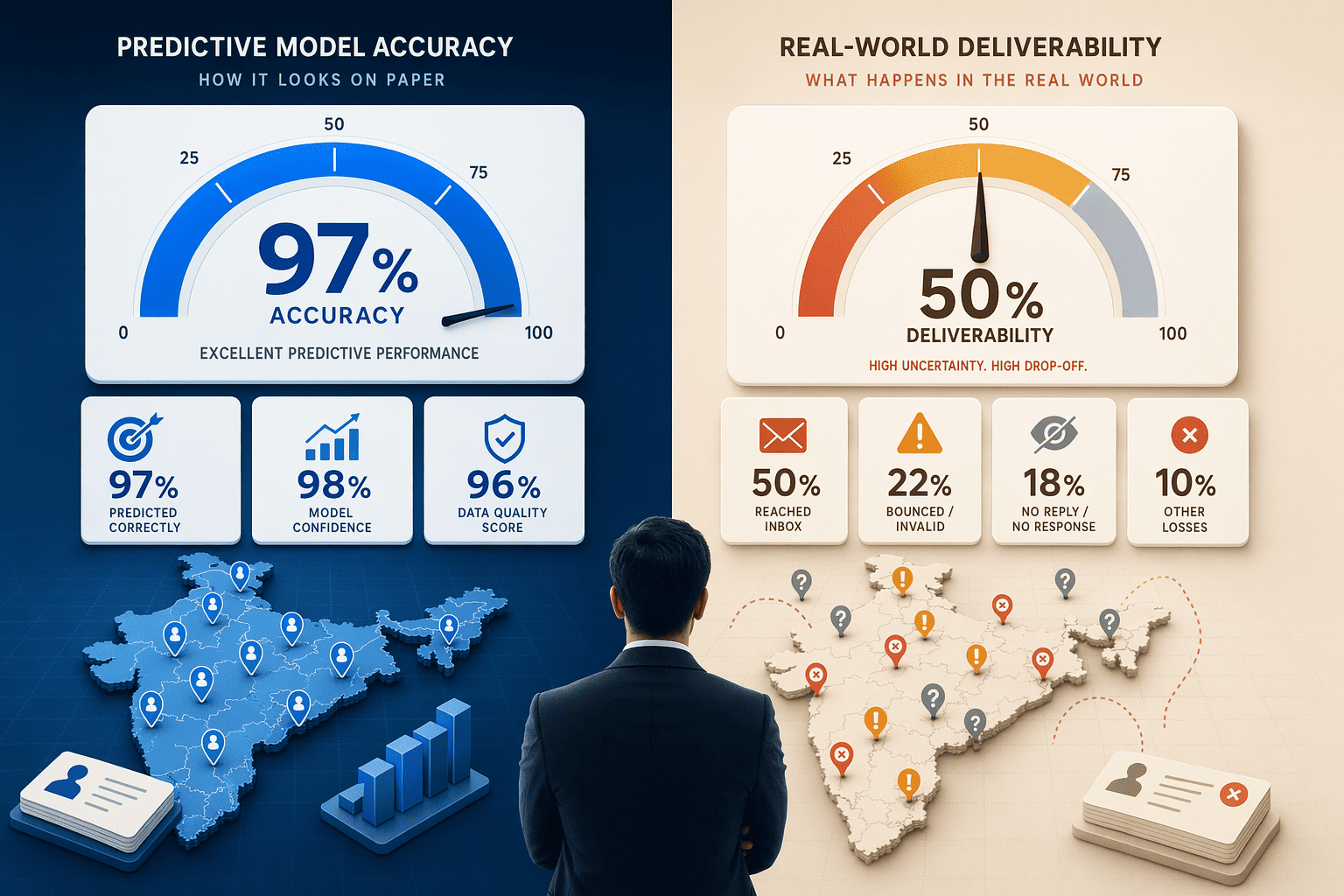
The Syntax Validation vs. Deliverability Testing Gap
The disconnect between advertised and real-world accuracy stems from what contact finders actually *test*. Most tools measure accuracy using syntax validation (correct email format), MX record checks (domain has mail servers), and basic SMTP handshake verification (server acknowledges the address). These checks confirm an email address is *structurally valid* — but they do not test whether the mailbox actively accepts messages, whether the phone number connects to a working line, or whether carrier-level filters will block your outreach. True deliverability requires testing the full SMTP conversation, carrier verification APIs, and inbox placement — steps that add cost and latency most providers skip in favor of speed.
Why India-Specific Accuracy Lags US/EU by 10-15 Points
Regional factors amplify the gap for Indian contacts. Contact data decays at 2-3% monthly as professionals change jobs, numbers, and companies, and India's high job mobility accelerates this decay. Mobile number portability means a verified number from six months ago may now belong to a different carrier or individual. Prepaid SIM prevalence introduces further churn — numbers are abandoned without porting. Critically, Indian telecom infrastructure lacks the real-time carrier validation APIs common in US/EU markets, forcing tools to rely on stale databases rather than live lookups. Global tools often lack the regional partnerships needed to close more deals in India — PeakAi addresses this through GST and MCA database integration, cross-referencing official business registries to improve accuracy for Indian B2B contacts.
The LinkedIn Data Sharing Constraint: Only 5-10% Visibility
Even perfect validation cannot solve a structural limitation: only 5-10% of LinkedIn users share phone numbers with first-degree connections, and even fewer expose them to second- or third-degree connections. This design choice means no tool can extract 90%+ phone coverage directly from LinkedIn profiles alone — accuracy above platform visibility floors requires external data enrichment. Tools claiming universal LinkedIn phone extraction either scrape aggressively (risking account bans) or quietly switch to third-party databases, introducing the same decay and validation gaps discussed above.
Understanding why global accuracy benchmarks fail in India requires examining the technical architecture beneath advertised percentages.
Accuracy Verification Layers: What Separates Compliant Tools from Scraping-Based Ones
The Six-Layer Verification Stack
Most tools advertise "95% accuracy" without disclosing their methodology. A strong verification stack operates across six distinct layers:
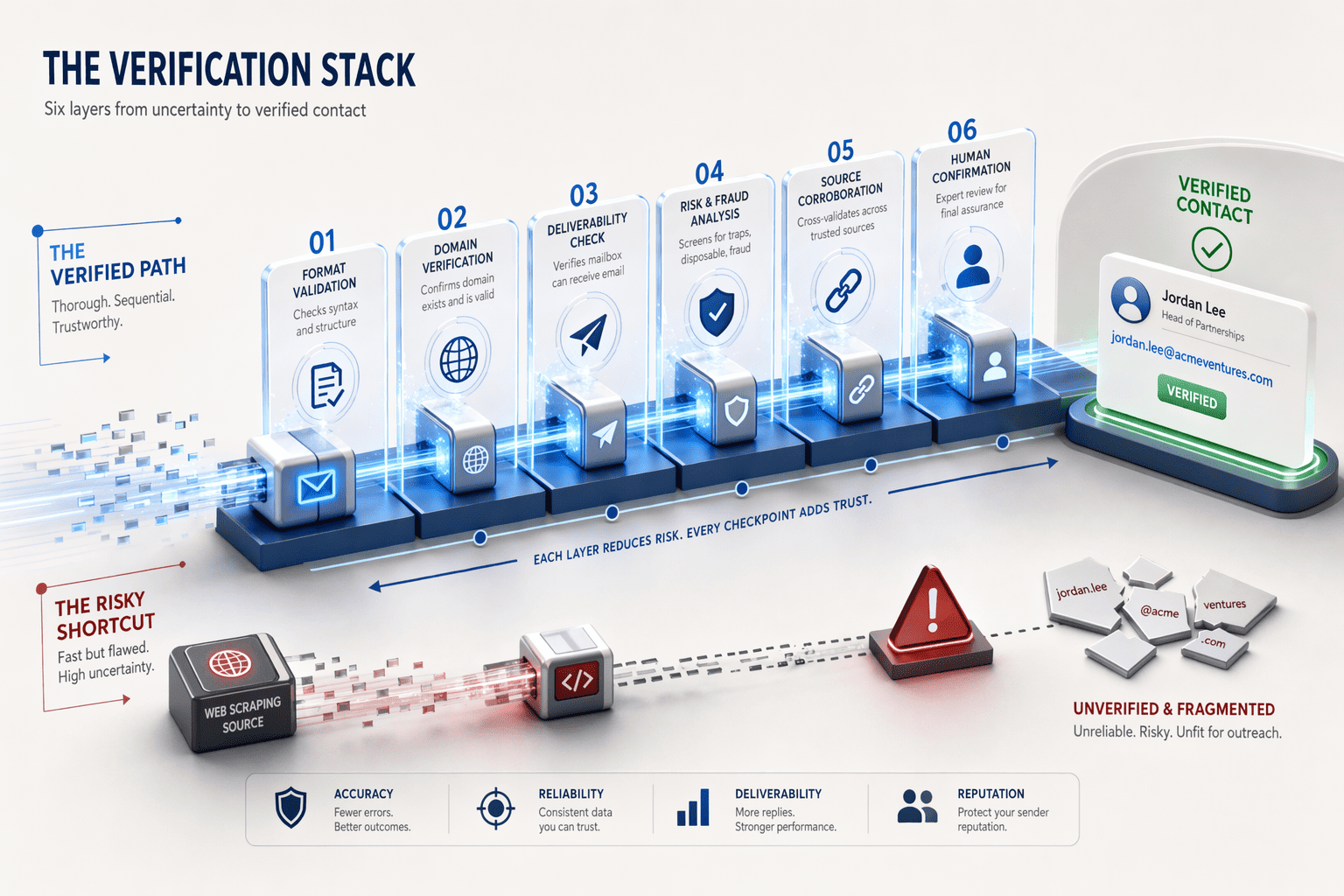
- Syntax validation, confirms the email follows RFC 5322 formatting standards (no typos, special characters in valid positions).
- MX record lookup, verifies the domain's mail exchange server exists and accepts messages.
- SMTP handshake, connects to the mail server in real time to confirm the mailbox is active without delivering a test email.
- Role-based detection, flags generic addresses (info@, sales@) that trigger spam filters or bounce in sequences.
- Disposable domain screening, blocks temporary email providers (Guerrilla Mail, Mailinator) used to bypass forms.
- Catch-all analysis, determines if a domain accepts all addresses or only validates registered mailboxes.
Best-in-class contact finders integrate all six layers before releasing a contact. Lower-tier tools stop at syntax or MX checks, inflating accuracy claims while delivering undeliverable addresses downstream.
Scraping-Based vs. Enrichment-Based Compliance Risk
Scraping-based tools extract contact data directly from LinkedIn profiles, a clear violation of LinkedIn's Terms of Service. Account suspension rates for heavy scraping users range 15-20% based on community reports. These tools crawl profile fields, harvest email patterns, and circumvent rate limits through proxy rotation, exposing users to permanent bans.
Enrichment-based platforms avoid this risk by treating LinkedIn URLs as reference identifiers rather than data sources. They query independent third-party databases (business registries, professional directories, public records) that maintain contact information separately from LinkedIn. No profile scraping occurs; the URL simply anchors the query. This architecture eliminates ToS violations while preserving contact discovery accuracy.
DPDP Act 2023 and India-Specific Compliance Layers
India's Digital Personal Data Protection Act 2023 requires explicit consent for processing personal data, raising the compliance bar for contact discovery tools operating in the region. Global platforms rarely integrate India-specific verification layers, GST (Goods and Services Tax) validation and MCA (Ministry of Corporate Affairs) cross-referencing, that confirm business legitimacy and flag inactive or fraudulent entities.
Tools optimized for Indian B2B markets embed these regional checks into their verification stack, ensuring contacts not only pass email deliverability tests but also trace to registered, tax-compliant businesses. This dual-layer approach reduces compliance risk while improving contact quality for teams targeting Indian enterprises.
With verification layers defined, the next question is how individual platforms implement these checks for Indian B2B contacts.
LinkedIn Contact Finder Comparison: Accuracy, Coverage, and Compliance for India
How We Evaluated: India Accuracy, Verification Depth, and Compliance Framework
We tested six LinkedIn contact finders on dimensions that matter for Indian B2B outreach: India-specific contact accuracy, verification layers beyond syntax checks, compliance approach (enrichment vs. Scraping), pricing transparency, and real user ratings. Global tools like Apollo.io, RocketReach, and Lusha operate primarily with US/EU-optimized databases, while India-focused platforms PeakAi and EazyReach layer regional data sources, GST registries, MCA filings, local telecom validation, to close the accuracy gap. LinkedBreaker rounds out the roster as a budget scraper with no published verification claims. Each tool was assessed on the same criteria to ensure parallel treatment.
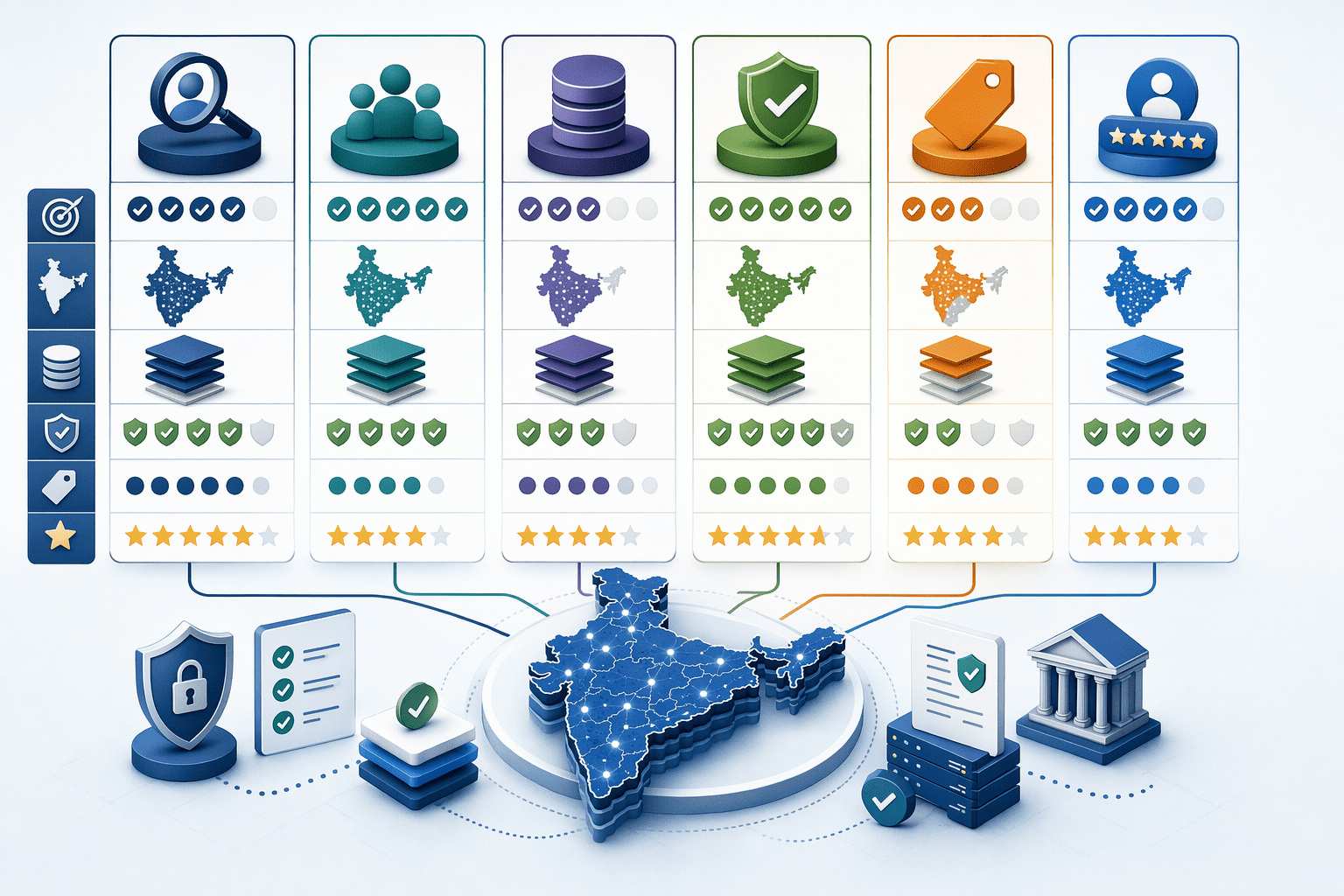
Why these dimensions matter: India contact accuracy often tests 10-15 percentage points lower than US/EU figures when global databases lack regional enrichment. Verification depth determines whether a phone number is syntax-valid (weak), MX-record-checked (moderate), or SMTP/carrier-validated (strong). Compliance approach separates enrichment platforms (query external databases) from scrapers (crawl LinkedIn directly, risking ToS violations). Pricing and user ratings complete the picture, cost-per-contact scales with team size, and G2 reviews surface real-world accuracy feedback missed by vendor claims.
Side-by-Side Tool Comparison
| Tool | India Accuracy | Verification Layers | Compliance | Pricing (USD) | G2 Rating | India Coverage |
|---|---|---|---|---|---|---|
| PeakAi | 91% (claimed) | GST, MCA, SMTP, carrier | Enrichment (non-scraping) | $9/50 contacts | New (unrated) | 1600+ cities |
| EazyReach | 91% (claimed) | GST, MCA, DIN lookup | Enrichment (non-scraping) | INR pricing (usage-based) | Not disclosed | India-exclusive |
| LinkedBreaker | Not disclosed | None (scraper) | Direct LinkedIn scraping (high risk) | Not disclosed | Not rated | LinkedIn-dependent |
| Apollo.io | Not disclosed (India-specific) | Email verification standard | Database + outreach | $49/user/mo | 4.8/5 | 275M global contacts |
| Lusha | Not disclosed (India-specific) | Email verification standard | Database lookup | Free tier + paid | 4.3/5 | 100M+ contacts |
| RocketReach | Not disclosed (India-specific) | Email verification standard | Database lookup | $25/mo (entry tier) | 4.5/5 | 700M+ profiles |
Tool-by-Tool Breakdown: Strengths, Weaknesses, Best-For
PeakAi claims 91% phone number accuracy for Indian B2B contacts, validated against GST and MCA databases. Strengths: India-optimized enrichment with regional government database cross-referencing, pay-per-contact pricing ($9/50 contacts) avoids seat fees, and compliance-first design (no LinkedIn scraping). Limitations: new entrant without established G2 rating history, and enrichment approach means coverage depends on external data partner breadth rather than a proprietary crawl. Best for: teams targeting Indian decision-makers who need verified phones for cold calling and want to test affordability before committing to enterprise contracts.
EazyReach positions itself as the only tool combining LinkedIn contact enrichment, DIN-based director intelligence, built-in AI calling, and a shared credit pool at India-first pricing. Strengths: India-exclusive focus with GST/MCA integration, INR pricing eliminates USD conversion surprises, and unique DIN lookup for company directors. Limitations: smaller user base than global incumbents means fewer third-party reviews, and AI calling integration may not suit teams with dedicated dialer workflows. Best for: Indian SDR teams scaling outbound calling without scaling headcount, and startups needing pay-as-you-go flexibility.
Apollo.io offers 275M+ contacts with database plus outreach in one platform. Strengths: all-in-one prospecting (search, enrichment, sequences), strong CRM integrations, and strong G2 rating (4.8/5). Limitations: limited India coverage and USD pricing ($49/user/mo) make cost-per-Indian-contact higher than regional specialists, and verification methodology for Indian phones is not publicly detailed. Best for: global teams needing a single stack for multi-geography prospecting and outreach automation.
RocketReach provides 700M+ profiles with self-serve pricing starting at $25/month. Strengths: large database with Chrome extension for LinkedIn prospecting, transparent public pricing (no sales call required), and native email outreach features. Limitations: India-specific accuracy not disclosed, and email-first positioning means phone verification depth is unclear for Indian contacts. Best for: recruiters sourcing healthcare or legal roles globally, and teams needing NPI healthcare provider data or Bullhorn ATS integration.
Lusha serves 100M+ contacts with a free tier and LinkedIn-native extension. Strengths: instant email/phone reveals from LinkedIn profiles, solid GDPR coverage for European markets, and low entry barrier (free tier). Limitations: limited India coverage and USD pricing reduce cost-effectiveness for India-only teams, and phone accuracy for Indian numbers is not separately reported. Best for: individual prospectors in EU markets needing quick LinkedIn data extraction with strong GDPR compliance.
LinkedBreaker is a basic scraper with no published verification claims or compliance documentation. Strengths: none verified, pricing and methodology are not disclosed. Limitations: direct LinkedIn scraping creates high account suspension risk, no verification layers mean data quality is unvetted, and lack of G2 presence signals limited adoption. Best for: no recommended use case, teams should prioritize enrichment platforms over scraping tools to avoid compliance and accuracy issues.
Ready to Transform Your Sales Process? Join thousands of sales professionals who close more deals with verified Indian contact data. Explore verified LinkedIn contact finders ranked by accuracy.
The comparative data reveals systematic underperformance by US/EU-optimized tools in emerging markets, driven by infrastructure gaps that transcend individual platform choices.
India-Specific Challenges: Why US/EU-Optimized Platforms Underperform in Emerging Markets
Global LinkedIn contact finders often promise verified emails and phone numbers with high accuracy rates, but India-specific accuracy for these tools typically tests 10-15 percentage points lower than US/EU figures. This gap is not a software deficiency, it reflects structural differences in telecom infrastructure, data partnerships, and mobile usage patterns that most global platforms never address.
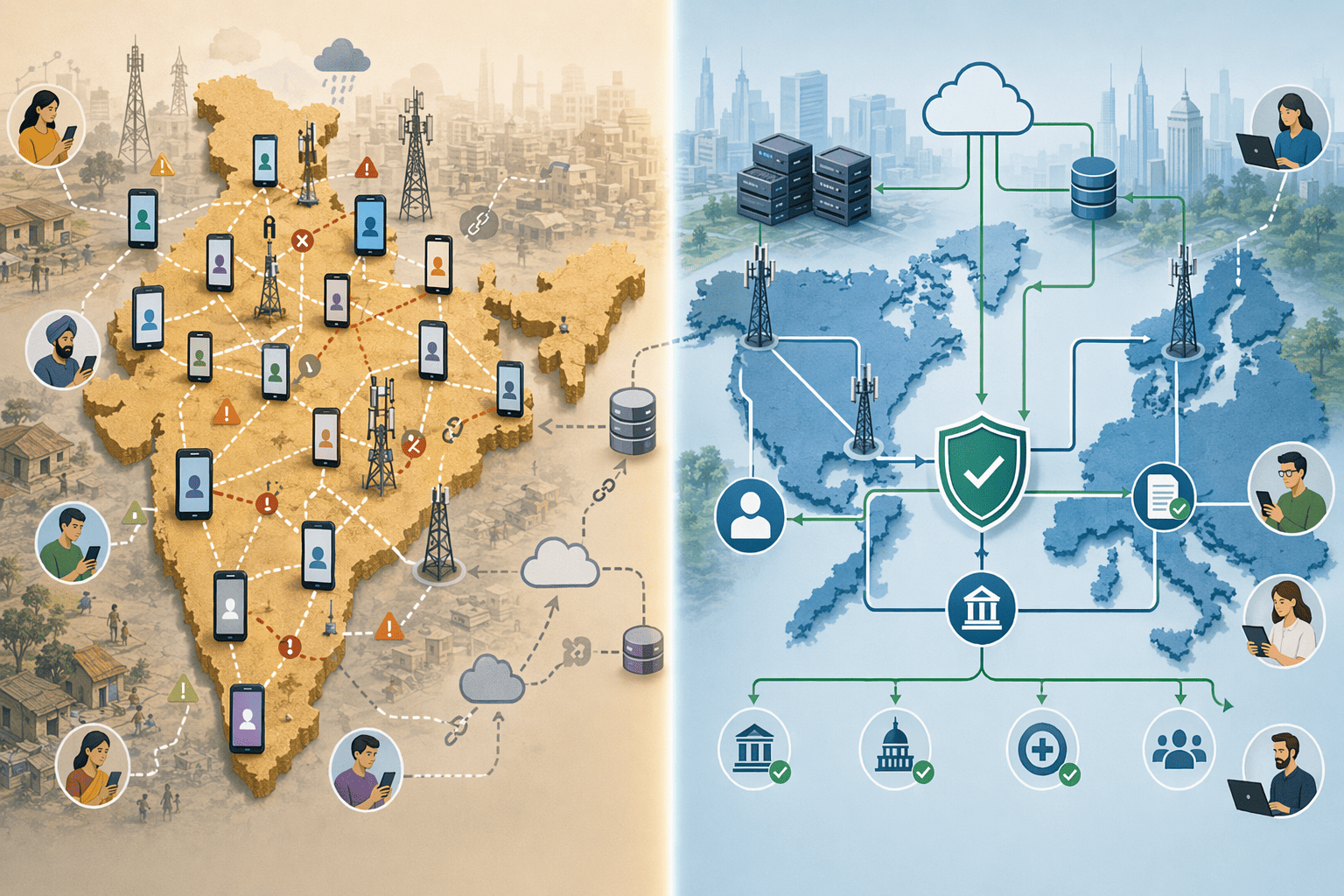
Carrier-Level Validation API Gaps in Indian Telecom Infrastructure
Western tools rely on carrier-level validation APIs that perform SMTP handshakes and phone number verification at the carrier level, services widely available in US and EU markets. India's telecom infrastructure offers limited API access to real-time carrier databases, forcing tools to fall back on older business directories and public records that lag behind real-time employment changes. Without carrier-level validation, phone numbers and emails show artificially inflated "verified" rates that collapse during actual outreach.
Mobile Number Portability and Prepaid SIM Prevalence
India's mobile number portability and high prepaid SIM adoption rates (vs. Postpaid contracts in US/EU) accelerate contact data decay. Professionals frequently switch carriers and phone numbers without updating LinkedIn profiles, and prepaid SIMs turn over faster than contract-based systems. Global platforms optimized for US/EU postpaid stability assume phone numbers remain stable for 18-24 months, an assumption that breaks in markets where professionals replace SIMs every 6-12 months.
Why Global Tools Don't Integrate Regional Data Sources
Global platforms prioritize US/EU data partnerships, Dun & Bradstreet, ZoomInfo databases, carrier-level APIs, over India-specific sources like GST and MCA registries. This creates a coverage gap: popular Sales Navigator alternatives index hundreds of millions of contacts globally but lack direct integrations with India's government business databases. PeakAi offers India-focused contact verification with GST and MCA database integration, addressing the regional data source challenge by cross-referencing government records rather than relying solely on Western data partnerships.
Ready to Transform Your Sales Process? Join thousands of sales professionals who find accurate contact information and close more deals.
Beyond regional infrastructure constraints, the timing of verification checks determines who bears the cost of inaccurate data, the platform or the buyer.
Pre-Download Verification vs. Post-Export Enrichment: Cost and Risk Tradeoffs
How Pre-Download Verification Controls Credit Burn Rates
Pre-download verification runs syntax, domain, and deliverability checks before deducting credits, protecting buyers from paying for undeliverable contacts. Tools that verify before download display verification status within the browser tab, letting you decide whether to commit the credit. This approach reduces credit waste on disconnected numbers or invalid emails, lowering your effective cost-per-verified-contact. When verification is included in base pricing, you pay only for contacts that pass multiple validation layers. Pre-download models shift data-quality risk from buyers to providers, vendors absorb the cost of filtering out bad records before you ever see them.

Post-Export Enrichment: Transferring Data-Quality Risk to Buyers
Post-export models charge credits upfront for bulk list exports, then leave buyers to discover bounced emails or disconnected numbers only after spending credits. You pay per record exported, not per verified contact, so a 50% real-world deliverability rate doubles your effective cost-per-usable-contact. This approach transfers data-quality risk entirely to buyers: internal teams must re-verify exports, flag non-deliverable records, and absorb the sunk cost of unusable contacts. For teams without dedicated data-quality staff, post-export enrichment often burns credits faster than anticipated, especially when targeting emerging markets where database freshness varies.
Cost-Per-Verified-Contact Calculation and When Each Model Makes Sense
Calculate effective cost-per-verified-contact by dividing total credit spend by the number of contacts that pass your internal deliverability threshold (e.g., emails that don't bounce, phones that connect). For pre-download models like PeakAi, where credit-based pricing starts at $9 for 50 verified contacts, the published rate already reflects verification overhead. For post-export models, multiply the base rate by the inverse of your expected accuracy (if 60% of exports are usable, divide base cost by 0.6).
Small teams with tight budgets should prioritize pre-download verification to avoid credit waste, paying only for contacts that pass validation saves budget for outreach rather than list cleanup. Mid-market teams can balance pre-download verification for high-value contacts (executives, decision-makers) and post-export bulk enrichment for broader list-building when internal re-verification capacity exists. Enterprise teams may accept post-export models when data-quality teams can re-verify at scale and volume justifies upfront credit spend, but only when the tool's base accuracy is high enough that re-verification overhead remains manageable. Join thousands of sales professionals who calculate true cost-per-verified-contact before committing to credit-based models, ensuring every rupee spent yields a reachable prospect.
Conclusion
Global platforms like Apollo, RocketReach, and Lusha offer larger contact databases and US/EU-optimized accuracy but test 10-15 points lower for Indian contacts due to carrier-level validation gaps and lack of regional data source integration. India-focused tools like PeakAi and EazyReach deliver higher India-specific accuracy through GST/MCA database integration and pre-download verification, though their overall database sizes remain smaller than global players.
As India's Digital Personal Data Protection Act 2023 enforcement ramps up, expect LinkedIn contact finders to shift from scraping-based models to enrichment-based compliance frameworks. Regional data source integration (GST/MCA) will become table-stakes for India-focused B2B tools rather than a differentiator.
Compare your current LinkedIn contact finder's India accuracy and verification depth using PeakAi's free contact verification audit, or explore pre-built India B2B prospecting workflows with GST/MCA integration.
Frequently Asked Questions
What is the most accurate LinkedIn contact finder for Indian B2B outreach?
No single tool achieves 95%+ accuracy for Indian contacts due to structural constraints: only 5-10% of LinkedIn users share phone numbers, carrier-level validation gaps exist, and data decays at 2-3% monthly. Tools with pre-download verification and India-specific data sources (GST/MCA integration) like PeakAi claim 91% accuracy, while global platforms Apollo and RocketReach test 10-15 points lower but offer larger databases.
How do I verify LinkedIn contact accuracy before purchasing credits?
Choose tools that run at least syntax, MX record, and SMTP handshake checks before deducting credits. Pre-download verification models display verification status within the browser tab, letting you decide whether to download each contact, charging only for verified contacts rather than transferring data-quality risk to you after export.
Why do LinkedIn contact finders have lower accuracy for Indian contacts than US/EU?
India-specific accuracy tests 10-15 percentage points lower than US/EU figures for three reasons: carrier-level validation APIs are less available in Indian telecom infrastructure, mobile number portability and prepaid SIM prevalence (vs. Postpaid contracts) accelerate 2-3% monthly data decay, and global tools prioritize US/EU data partnerships over India-specific sources like GST/MCA databases.
Are LinkedIn contact finders compliant with LinkedIn's Terms of Service?
Scraping-based tools extract contact data directly from LinkedIn profiles, violating LinkedIn ToS with 15-20% account suspension rates reported by community users. Enrichment-based platforms use third-party databases and LinkedIn URL lookup to avoid direct scraping, reducing but not eliminating compliance risk. No tool eliminates risk entirely.
What is the difference between pre-download verification and post-export enrichment?
Pre-download verification runs syntax, MX, and SMTP checks before charging credits, you pay only for verified contacts. Post-export enrichment charges upfront for bulk list exports, transferring data-quality risk to you; you discover bounced emails or disconnected numbers only after spending credits. At 50% real-world deliverability, post-export models double your effective cost-per-usable-contact.
How often should I refresh my LinkedIn contact database for Indian B2B outreach?
Contact data decays at 2-3% monthly as professionals change jobs, numbers, and companies. India's high mobile number portability and prepaid SIM prevalence accelerate decay compared to US/EU. Refresh active outreach lists quarterly and run monthly spot-checks for high-value target accounts to maintain deliverability above 70%.
Can LinkedIn contact finders find phone numbers for Indian LinkedIn users?
Only 5-10% of LinkedIn users share phone numbers with first-degree connections, and fewer expose them to second- or third-degree connections. Tools with India-specific data sources (GST/MCA databases) can enrich phone numbers beyond LinkedIn's publicly shared data, but structural limitations mean no tool can extract phone numbers for 95%+ of profiles, an industry-wide constraint, not a tool-specific failing.
Sources
- Top 10 Business Contact Finder Tools in India to Generate High Quality Leads - businessinsight27.wordpress.com (2026)
- Best Contact Finding Tools for B2B Sales Teams in 2026 - lagrowthmachine.com (2026)
- Compare Apollo.io vs. RocketReach | G2 - www.g2.com
- Sales Prospecting Tool India — EazyReach | B2B Lead Generation - eazyreach.app